Applying for a Birth Certificate in Spain: How to Request One Online, in Person or by Post
Before starting the procedure: requirements and procedures may change. Check the information applicable to your case and consult the relevant official sources.
Updated guide
Birth Certificate in Spain: How to Apply Step by Step
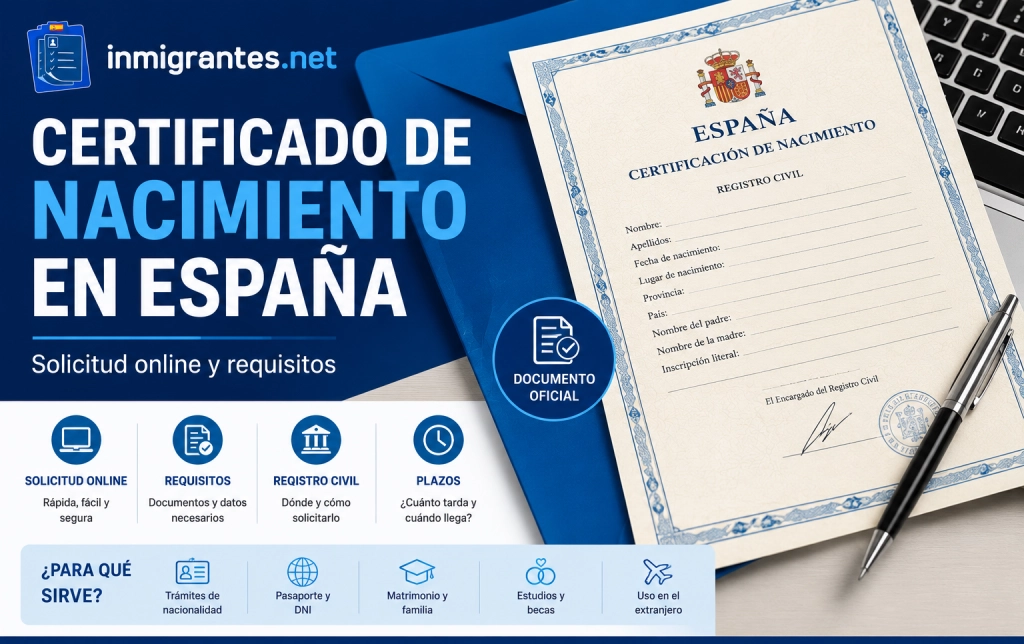
A birth certificate officially certifies the birth details recorded in the Civil Registry and may be required for Spanish citizenship, a DNI, a passport, marriage, family procedures, studies or processes abroad.
Document
Birth certificate
Authority
Civil Registry
Application
Online, in person or by post
Types
Full, extract or multilingual
Quick summary
- The birth certificate officially certifies a person's birth and the details recorded in the Civil Registry.
- It can be requested online, in person at the Civil Registry or by post, depending on the circumstances.
- Many procedures require a full birth certificate, especially when it is to be submitted to a public authority.
- If the certificate will be used abroad, you may need to request a multilingual version, have it apostilled or get it translated.
- For Spanish citizenship applications, check whether the certificate must be recent, legalised and translated, depending on the country of origin.
Applying for a birth certificate in Spain is one of the most common document-related procedures. The certificate may be required to obtain or renew documents, start a citizenship application, get married, prove parentage, complete family procedures, manage an inheritance or submit documents to Spanish or foreign public authorities.
Although this is a common document, many people have questions about which type of certificate to request, where to apply, whether they can get it online, whether it is accepted for Spanish citizenship applications, whether it expires or whether it needs an apostille. This guide explains the process in practical terms.
Key point
Not all birth certificates are suitable for every procedure. If an authority asks you for a “full certificate”, you should not submit an extract. If the document is to be used outside Spain, you may need a multilingual format, an apostille or an official translation.
What is a birth certificate?
A birth certificate is a document issued by the Civil Registry that certifies a person’s birth. It may include details such as the person’s first and last names, date, time and place of birth, sex, parentage and other information recorded in the register.
This document serves as official evidence for public authorities, entities and organisations that need to verify a person’s identity, birth or parentage.
In Spain, births are registered with the relevant Civil Registry. If a Spanish citizen was born abroad, the birth may be registered with a Consular Civil Registry or the Central Civil Registry, depending on the circumstances.
What is a birth certificate used for?
A birth certificate may be required for a wide range of procedures. Some of the most common include:
Spanish citizenship
It may be required for citizenship applications, particularly to prove identity, parentage or birth.
DNI and passport
It may be requested to obtain certain identity documents or in specific cases involving a renewal or change of details.
Marriage and family
It is used for marriage applications, parentage procedures, adoptions, inheritances and family proceedings.
Procedures abroad
It may be needed for consulates, visas, foreign registries, recognition procedures or international applications.
If you are gathering documents for a citizenship application, you can also consult the guide to documents required to apply for Spanish citizenship and the specific article on whether a birth certificate expires when applying for citizenship.
Types of birth certificates
Before applying, it is a good idea to choose the right type of certificate. The most common are the full certificate, the extract and the multilingual certificate.
| Type | What it includes | When to request it |
|---|---|---|
| Full certificate | Provides a complete reproduction of the details recorded in the birth register. | It is generally the most suitable option for administrative procedures, citizenship applications, DNI, passports or official applications. |
| Extract | Summarises the essential details recorded in the register. | It may be suitable when a full certificate is not required. |
| Multilingual | Issued in a multilingual format for certain international uses. | Useful when it must be submitted in countries that accept this format. |
| Negative | Confirms that no registration is recorded in a particular Civil Registry. | It can be requested when you need to prove that a birth is not registered in a specific registry. |
Practical tip: If you are not sure which one to request, check exactly what the organisation receiving the document requires. For many official procedures, the safest option is usually to request the full birth certificate.
How to apply for a birth certificate online
The most convenient way to request a birth certificate is through the Ministry of Justice’s Government online portal. There are several options, depending on whether you have electronic identification.
1. My birth certificate in one click
This option lets you obtain a full birth certificate quickly when it can be issued automatically. To use it, you will usually need to identify yourself using Cl@ve or another accepted identification system.
This is the easiest option if the certificate is for you, your details can be verified correctly, and you do not need a special format.
2. Apply using Cl@ve
You can use Cl@ve to request a certificate for yourself or another person, as applicable. The form offers more options than the quick procedure and may be necessary if you need a special certificate, a certificate for someone else or a specific type of certificate.
3. Apply without using Cl@ve
You can also request Civil Registry certificates without identifying yourself through Cl@ve by completing a more detailed form. This option may be useful if you do not have a digital certificate or Cl@ve, although you may need to provide more information to locate the registration.
Recommended official link
To avoid intermediary websites or unnecessary paid services, use the Ministry of Justice’s official Government online portal: Birth certificate – Government online portal.
Steps to apply online
- Go to the official birth certificate procedure on the Government online portal.
- Choose the appropriate option: certificate in one click, application using Cl@ve or application without Cl@ve.
- State whether the certificate is for you or someone else.
- Select the type of certificate you need: full, extract, multilingual or another type.
- Enter the details of the person whose birth was registered: first name, surname(s), date and place of birth.
- Add the Civil Registry details, if you know them, such as the volume and page, when requested.
- State the purpose of the certificate and how you would like to receive it.
- Check all the details before submitting the application.
- Keep the receipt or application number for future enquiries.
If the information is available electronically, the certificate may be issued immediately. If not, the system may tell you whether it will be sent by post or whether you need to take further steps.
How to apply in person at the Civil Registry
You can also request a birth certificate in person. This usually means going to the Civil Registry where the birth is registered, or to the relevant authority, depending on the circumstances.
Before travelling, check whether you need an appointment, the opening hours, and whether the registry can issue the certificate immediately or will send it later.
For an in-person application, you may need to provide:
- The applicant’s identity document.
- The details of the person whose birth was registered: first name, surname(s), date and place of birth.
- Registration details, if known: Civil Registry, volume, page or section.
- Authorisation or proof of legitimate interest if applying on behalf of someone else.
- Application form, if required by the office.
How to apply by post
In some cases, you can apply for a birth certificate by post. This option may be useful if you cannot go to the Civil Registry and cannot complete the application online.
To avoid delays, include as many details as possible about the registration and a complete postal address where the certificate can be sent. If important details are missing, the Civil Registry may be unable to locate the registration or may request further information.
Common mistake
Applying to the wrong Civil Registry or providing incomplete details can significantly delay the process. If you know the municipality, exact date of birth, parents’ names or registration details, always include them.
Who can apply for a birth certificate
The person whose birth was registered can apply for their own birth certificate. Their legal representatives or authorised persons can also apply, as can third parties who demonstrate a legitimate interest in certain cases.
When applying on behalf of someone else, you may be asked for additional details or documents to justify your relationship with the person whose birth was registered or the purpose of the certificate.
The person concerned
They can apply for their certificate if they are an adult and can provide valid identification.
Legal representative
For example, parents or guardians applying for minors or people who are legally represented.
Authorised person
They may need express authorisation and documents proving their authority to act on the person’s behalf.
Third party with a legitimate interest
They must explain the purpose of the request and its connection to the procedure for which the certificate is being requested.
Information needed to apply for the certificate
The more information you provide, the easier it will be to locate the registration. You will normally be asked for the following details:
- Full name of the person whose birth was registered.
- Date of birth.
- Place of birth: municipality, province and country, if applicable.
- Parents’ names, if requested.
- Civil Registry where the birth was registered.
- Volume and page, if known.
- Type of certificate requested.
- Purpose for which it is needed.
- Postal address or delivery method, where applicable.
If you need the certificate for Spanish citizenship, carefully check the names, surnames and dates. Even a minor discrepancy between documents can lead to requests for further information or delays.
Birth certificate for Spanish citizenship
A birth certificate is one of the most important documents in many Spanish citizenship application files. Depending on the procedure, you may need a certificate from your country of origin, a Spanish certificate, a full certificate, legalisation, an apostille or a sworn translation.
If the certificate was issued in another country, a simple copy is not enough. In many cases, it must be legalised or apostilled and translated by a sworn translator if it is not in Spanish.
To prepare your application file, you can also read the guide to documents required to apply for Spanish citizenship and practise with the Spanish citizenship test.
Does a birth certificate expire?
A birth certificate confirms a registration in the Civil Registry, but many authorities require the document to be recent. So, although the fact of birth does not change, a certificate may be rejected if it is too old for the specific procedure.
For citizenship, immigration, marriage or international applications, it is advisable to check the maximum age accepted by the authority requesting the certificate.
Recommendation
If you are submitting the certificate as part of an important application, request an up-to-date copy shortly before submitting your documents. This will help you avoid requests for additional documents because the certificate is too old.
Birth certificates for use abroad
If you need to submit a birth certificate outside Spain, check which format the destination country requires. A multilingual certificate may be sufficient in some cases, while other procedures may require an apostille, legalisation or official translation.
A multilingual format can make international procedures easier, but it does not always replace an apostille or legalisation. The practical rule is simple: before requesting the certificate, ask the foreign authority which format it accepts.
Common mistakes when requesting a certificate
Requesting the wrong type
An extract may not be accepted if you are required to provide a full certificate.
Not checking the purpose
Some certificates must state a specific purpose, such as a DNI, passport or citizenship application.
Incomplete details
Without the date, municipality or correct Civil Registry, it may be difficult to locate the registration.
Forgetting the apostille or translation
For international use, the document may not be valid if it has not been legalised or translated.
Frequently asked questions about requesting a birth certificate
How can I request a birth certificate in Spain?
Depending on your circumstances and the type of certificate you need, you can request it online through the Ministry of Justice's Government online portal, in person at the relevant Civil Registry or by post.
Which birth certificate do I need for Spanish citizenship?
Many application files require a full birth certificate. If the document was issued abroad, it may need an apostille or legalisation and a sworn translation if it is not in Spanish.
Can I request a birth certificate online without Cl@ve?
Yes, you can submit a request without identifying yourself through Cl@ve, although applying with Cl@ve may allow for a more complete process and, where available, immediate issuance.
What is the difference between a full certificate and an extract?
A full certificate reproduces the birth registration in greater detail. An extract summarises the main details. For an official procedure, it is generally safer to request the full certificate.
How long does it take to get a birth certificate?
If online issuance is available, you may be able to obtain it immediately. Otherwise, it may be sent by post or require additional steps, depending on the Civil Registry and whether the information is available.
Can I request someone else’s birth certificate?
Yes, but you may need to provide proof of representation, authorisation or legitimate interest, especially if you are neither the person named on the registration nor their legal representative.
Do I need to get the birth certificate apostilled?
Only if the document is to be used abroad and the receiving country or organisation requires it. In some cases, a multilingual certificate may be accepted, but it does not always replace the apostille.
Conclusion
Applying for a birth certificate in Spain is straightforward if you choose the right type of certificate and provide the correct details. For important procedures, especially citizenship, marriage, a DNI, a passport or use abroad, check whether you need a full birth certificate, a multilingual certificate, an apostille, legalisation or an official translation.
The best option is usually to start with the Ministry of Justice’s official Government online portal and always keep your application receipt.
Official sources
This content is for informational purposes only and does not replace professional legal advice or information provided by the competent authorities.