Guides by topic

Immigration and Residence

Guides and resources on immigration and residence in Spain.

Immigration Office in Madrid: appointments, locations and procedures

Immigration Office in Madrid: appointments, locations and procedures

The Immigration Office in Madrid is the main point of contact for many procedures relating to residence, work, family reunification, arraigo residence routes, renewals, submitting documents and checking immigration applications in the province of Madrid.

This guide provides clear, up-to-date information on where the Immigration Office in Madrid is located, how to book an appointment, which locations there are, what documents you should prepare and how to check your application status. You’ll also learn the difference between procedures handled by the Immigration Office and those usually carried out by the National Police, such as fingerprinting or collecting your TIE.

Quick summary

Key information about the Immigration Office in Madrid

Main officeCalle Silva, 19
28004 Madrid
Information phone number91 272 95 00
General opening hoursMonday to Friday
from 9:00 to 14:00
TipAlways check your appointment and the office location before you go.

Important: Immigration procedures are not all handled at the same location. Some are handled by the Immigration Office, while others are dealt with by the National Police, particularly those involving fingerprinting, issuing or collecting the Foreigner Identity Card (TIE). Make sure you check the specific procedure before booking an appointment.

[toc]

Immigration Office in Madrid: appointments, locations and procedures

What is the Immigration Office in Madrid?

The Immigration Office in Madrid is part of the General State Administration and handles numerous procedures for foreign nationals who live, work or study in Spain, or who wish to regularize their immigration status.

Common searches include Madrid immigration appointment, Madrid immigration office, checking an immigration application, Arraigo social in Madrid (social-integration residence route), residence permit renewal and family reunification.

In practice, this office may handle residence applications, work authorizations, family reunification, exceptional circumstances, renewals, duplicate documents, document submissions and issues relating to applications that have already been submitted.

Immigration Office locations in Madrid

Official information currently lists several locations associated with immigration services in Madrid. Always check the location stated on your appointment confirmation, as going to the wrong address could mean missing your appointment.

Location Address Useful information
Silva office Calle Silva, 19
28004 Madrid
Main office. Santo Domingo and Callao metro stations. General opening hours: Monday to Friday, 9:00 to 14:00.
García de Paredes office Calle García de Paredes, 65
28010 Madrid
For general document submissions and duplicate document collection. Gregorio Marañón metro station. General opening hours: Monday to Friday, 9:00 to 14:00.
Leganés office Calle San Nicasio, 31
28911 Leganés
Office in Leganés. MetroSur, Leganés Central station. General opening hours: Monday to Friday, 9:00 to 14:00.

How to book an immigration appointment in Madrid

For most in-person procedures, you need to book an immigration appointment in Madrid. The appointment system lets you select the province and procedure and, if appointments are available, the date and time.

How to book an appointment

  1. Go to the official immigration appointment system.
  2. Select the province of Madrid.
  3. Choose the correct procedure: application, information, document submission, Police, fingerprinting, TIE, or another available option.
  4. Enter your personal details exactly as they appear on your documents.
  5. Select an available appointment, if the system shows any.
  6. Save or print your appointment confirmation, as you may need it to enter the office.

If no appointments are available, this does not necessarily mean the procedure is unavailable. Appointments sometimes fill up quickly or are released at different times. Check that you have selected the correct province and type of procedure, and try again later.

Who should book the appointment for each procedure?

A common mistake is for someone other than the appropriate person to book the appointment. Depending on the type of procedure, the application may need to be submitted by the foreign national, the employer, the family reunification sponsor, the minor's parent, or an authorised representative.

Initial employment authorizationThis should normally be handled by the employer or their authorised representative.
Family reunificationThe appointment is usually booked by the family reunification sponsor or their authorised representative.
Minors or legally incapacitated personsThe appointment may be booked by a parent or legal representative.
Other authorisationsThe appointment may be booked by the foreign national or their authorised representative.

What procedures can be handled at the Madrid Immigration Office?

The available procedures may vary by province, time, and office. In Madrid, however, people often enquire about procedures related to residence, work, family reunification, exceptional circumstances, renewals, document submissions, duplicate documents, and application issues.

  • Residence and work authorisations, where applicable to the type of application.
  • Family reunification for family members of residents in Spain.
  • Residence on exceptional grounds, such as arraigo social (social-integration residence route), arraigo familiar (family-based residence route) or arraigo laboral (former employment-related residence pathway).
  • Renewals or changes to residence authorizations.
  • Submitting documents for applications in progress.
  • Enquiries, duplicate documents and issues relating to applications already submitted.
  • Online submission through platforms such as Mercurio, where the procedure allows it.

Useful internal links

If you are preparing for a specific procedure, these guides may also help:

Common documents for Spanish immigration procedures

The exact documents required depend on the procedure. An arraigo application, a renewal, a family reunification application and an initial residence and work authorization application all have different requirements. However, some documents are commonly required in many procedures.

Basic checklist

  • A complete, valid passport, where applicable.
  • Your NIE or identification document, if you already have one.
  • The official form for the relevant procedure.
  • Proof of payment of the fee, if required for the procedure.
  • Documents supporting your personal, employment, family or financial circumstances.
  • Previous decisions, if you are renewing or changing an authorization.
  • Additional documents required by the information sheet for the specific procedure.

Before attending your appointment, check the information sheet for the specific procedure. Incomplete documents may lead to requests for additional documents, delays or the need to submit further documents.

How to check the status of a Spanish immigration application

If you have already submitted an application, you can check its status online or through the available channels. You will usually need details such as your NIE, application reference number or personal information associated with the application.

Common ways to check

  • Check your application status online through the government online portal.
  • Telephone 060 for general information.
  • Telephone 902 022 222, when available for checking application status.
  • Check by SMS using the word NIE or EXPE, depending on which detail you want to use.

If the system says it could not find the requested information and the details are correct, the application may not yet have been entered into the computer system. In that case, it is best to wait and check again later.

Difference between the Immigration Office and the National Police

A common misconception is that all Spanish immigration procedures are handled at the same office. This is not always the case.

Immigration Office

It usually handles applications, renewals, residence and work authorizations, family reunification, arraigo applications (residence routes based on ties to Spain), submissions of additional documents, and issues with applications.

National Police

It usually handles documentation procedures, fingerprinting, issuing or collecting TIE cards, certificates, NIE assignments, and return authorizations.

So, when you access the appointment booking system, check whether the selected procedure is handled by the Immigration Office or the National Police. Choosing the wrong procedure may mean the appointment cannot be used for what you need.

What to do if no appointments are available

Appointments are often unavailable at certain times. If you cannot find an appointment for immigration procedures in Madrid, try these recommendations:

  • Check that you have selected the correct province and procedure.
  • Try at different times of day, as availability may change.
  • Do not book an appointment for a different procedure just to get a slot.
  • Check whether you can submit your application online.
  • Prepare all your documents before the appointment to avoid wasting time.
  • If you experience a technical issue with the appointment system, use the official support channels.

General guidance

Do you have questions about your immigration procedure?

If you are unsure which appointment to book, which documents to submit, or how to check your application status, you can request guidance before visiting the office.

Request an online consultation

Frequently asked questions about the Immigration Office in Madrid

Where is the Immigration Office in Madrid?

The main office is at Calle Silva, 19, 28004 Madrid. There are also immigration-related offices at Calle García de Paredes, 65, and Calle San Nicasio, 31, in Leganés.

What are the Immigration Office’s opening hours in Madrid?

The general opening hours listed for the offices are Monday to Friday, from 9:00 to 14:00. However, it is advisable to confirm the opening hours and location before visiting, especially on public holidays or during periods of administrative changes.

How do I book an appointment with the Immigration Office in Madrid?

You can book an appointment through the official immigration appointment system. Select the province of Madrid, choose the correct procedure, enter your details, and save your appointment confirmation.

Can I visit the Immigration Office without an appointment?

An appointment is required for many procedures. If you arrive without one, you may not be seen or may only receive general information. The safest option is to check the specific procedure and book an appointment before travelling to the office.

What is the Immigration Office’s phone number in Madrid?

The information phone number listed in the official information for Madrid’s immigration services is 91 272 95 00. For questions about appointments, you can also call 060.

Where can I have my fingerprints taken for the TIE?

Fingerprinting, issuance, and collection of the Foreigner Identity Card (TIE) are usually handled by the National Police, not necessarily by the Immigration Office. When booking an appointment, select the correct procedure related to the police/TIE.

How can I check the status of my immigration application?

You can check your application status online, by phone, or through the available enquiry channels. You will need details such as your NIE, application reference number, or information associated with your application.

What should I do if my application does not appear?

If the information you entered is correct and the system cannot find it, your application may not yet have been entered into the system. If so, wait and check again later.

Final note: administrative information may change. Before visiting an office or submitting documents, always check your appointment, the procedure selected and the official instructions for your application.
How to check the status of an immigration application

How to check the status of an immigration application

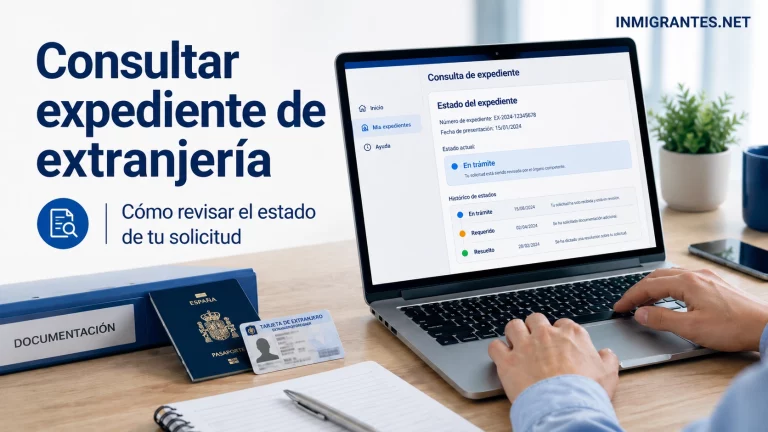
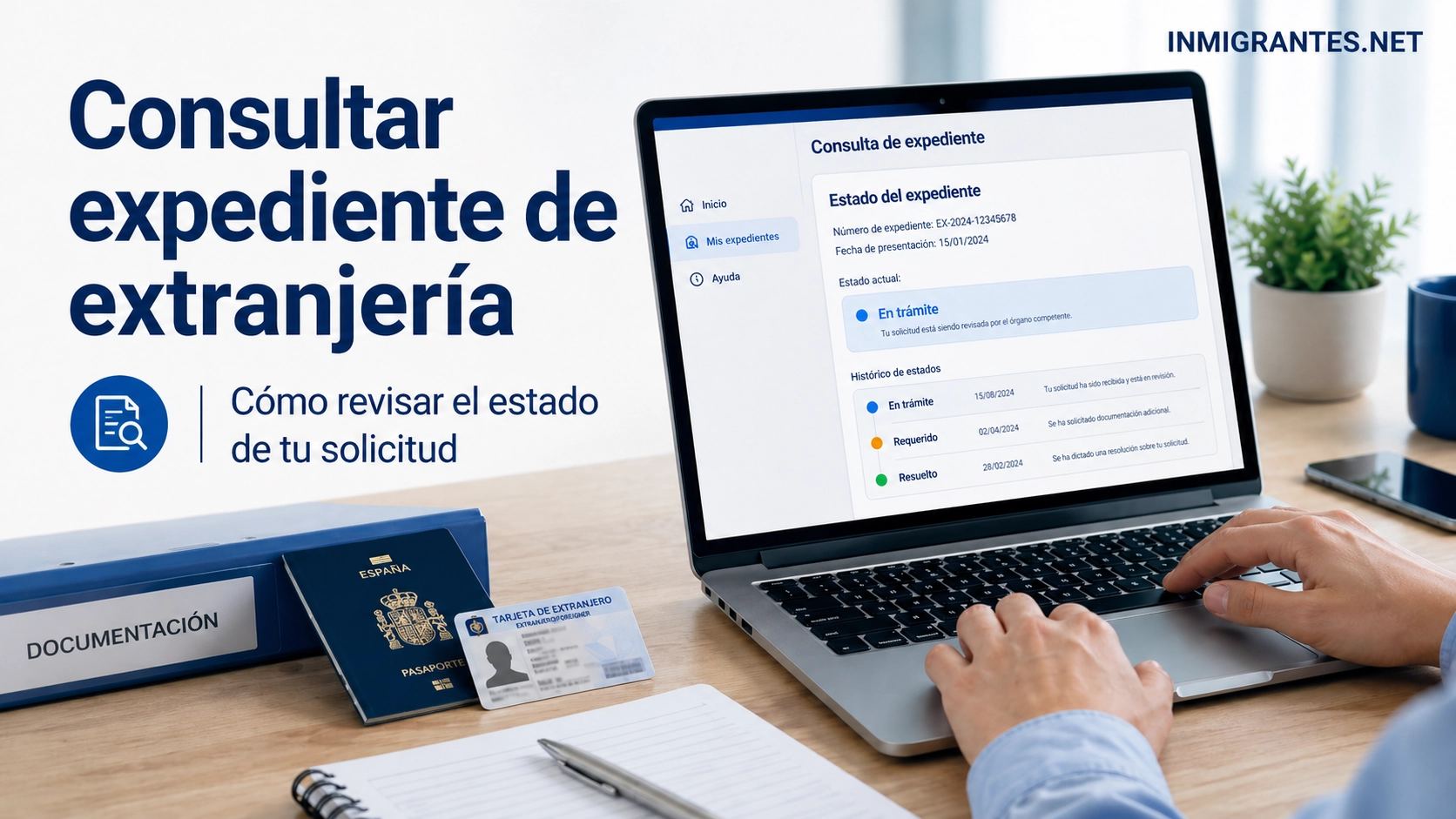
Checking the status of a Spanish immigration application is one of the most common tasks after submitting an application for residence, renewal, arraigo, family reunification, a return authorization, a change of authorization or any other procedure to an Immigration Office.

This guide explains how to check your immigration application online, by SMS and by phone, what information you need, what each status means, what to do if your status says “additional action required”, “approved”, “archived” or “the requested information could not be found”, and how to avoid errors that could delay your application.

Quick summary

Ways to check an immigration application

Online enquiryUsing Cl@ve or the form on the Government online portal.
SMS enquirySend your NIE or EXPE to the designated official number.
Telephone enquiryCall the information number provided by the Administration.
Key pointThe status shown is for information purposes and may take time to update.

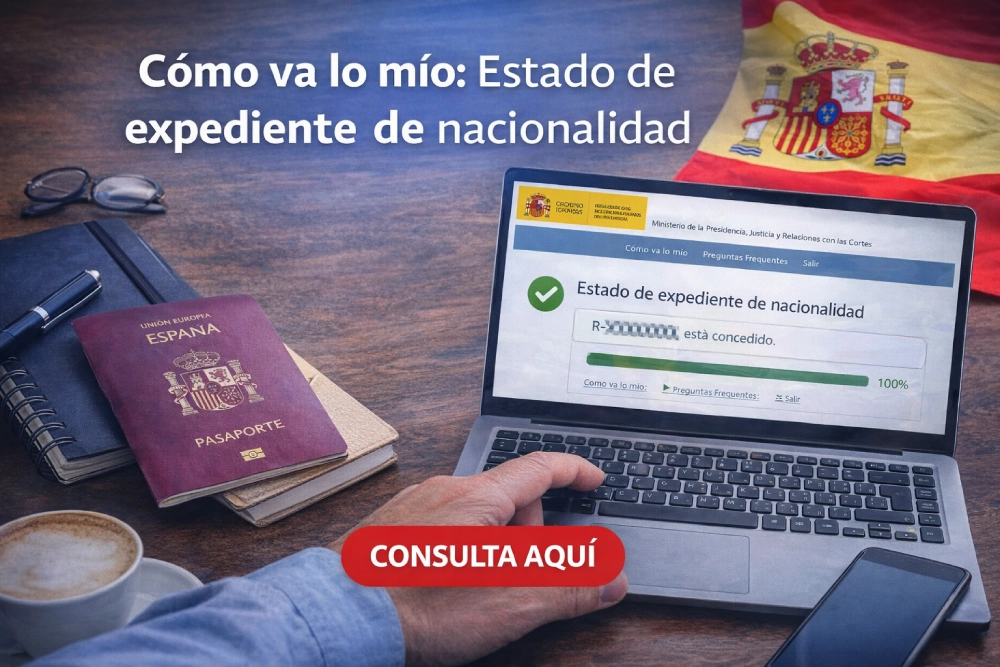
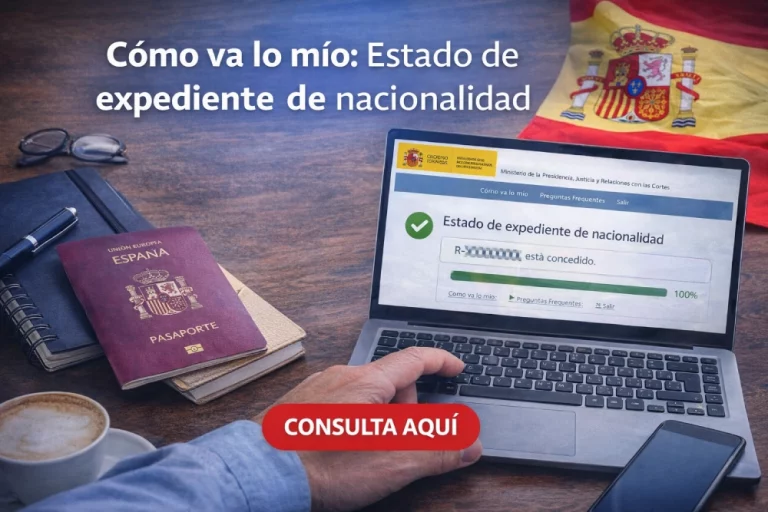
Important: This service is intended for immigration applications handled by Immigration Offices. If your application is for Spanish citizenship, you should normally check it through “Cómo va lo mío” on the Ministry of Justice website, not through the general immigration application system.

[toc]

How to check the status of an immigration application
How to check the status of a Spanish immigration application

What is the status of an immigration application?

When you submit an immigration application, the Administration opens an administrative case. It goes through different stages: registration, review, requests for reports, requests for documents, a decision, notification or archiving.

The status of an immigration application is the message you see when you check how your application is progressing. It may not provide all the details, but it can tell you whether your application is still being processed, whether a decision has been made, whether documents are missing or whether there is an issue.

This check is useful for procedures such as arraigo social (social-integration residence route), arraigo familiar (family-based residence route), temporary residence, family reunification, long-term residence, work authorizations, renewals, changes of authorization or extensions of stay.

How to check your immigration application online

The easiest way is to check online through the Government Administrations’ Electronic Office. You can access the system using electronic identification or by completing a form with your application details.

Steps to check online

  1. Go to the official page for checking immigration applications.
  2. Choose whether to sign in with Cl@ve or use the form.
  3. Enter the requested details: NIE, application reference number, submission date or year of birth, depending on the method you choose.
  4. Check that there are no errors in the letters, numbers or dates.
  5. Click Check and review the status displayed.
  6. Save a screenshot or note down the status and the date you checked it if you need to follow up.

Details you need to check your application

Before checking, it is a good idea to have your application documents to hand. Depending on how you access the system, you may be asked for some of the following details:

  • NIE, if you have already been assigned a Foreigner Identification Number.
  • Application reference number, usually 15 characters long.
  • Application submission date.
  • Applicant’s year of birth.
  • First and last names as they appear on the application.
  • Proof of submission, especially if the application does not appear yet.

Related guides

If you are following up on a specific procedure, these pages may also be helpful:

How to check your immigration application by SMS

You can also check your application status by SMS. This is a convenient option if you do not have internet access at the time or want a quick reply with basic information.

Type of check What to write Example
Check by NIE NIE + space + your full NIE NIE X00000111L
Check by application reference number EXPE + space + application reference number EXPE 280020101234567

Send the message to the official number provided by the Electronic Office for this service. The NIE must start with X, Y or Z, contain 8 digits and end with a letter. If the number has fewer digits, add zeros at the beginning.

Tip: check the spaces carefully. There must be a space between NIE or EXPE and the number. If the application reference number is not exactly 15 characters long, the system may return an error.

How to check your application status by phone

Checking by phone can be useful if you cannot access the online service or need to confirm basic information. The Government online portal states that you can obtain information by calling the telephone number provided for checking application status.

Keep in mind that the information provided through this service is for guidance only. For important actions, such as responding to a request for additional documents, appealing a decision or submitting documents, always check the official notification.

Have these details ready before you call

  • Your NIE or application reference number.
  • The applicant’s first and last name.
  • Date of birth.
  • Date you submitted the application, if you have it.
  • Type of application submitted: arraigo (a Spanish residence route based on ties to Spain), renewal, family reunification, long-term residence, etc.

What each Spanish immigration application status means

The system may display different statuses. Some are straightforward, while others can be confusing. This table will help you understand the most common ones:

Status What it means What to do
In progress The application is being reviewed and no decision has been made yet. Wait and check the status and notifications regularly.
Additional documents required The authorities need additional documents or clarification. Check the official notification and submit the requested documents within the deadline.
Approved The application has been approved. Wait for the notification and check whether you need to book an appointment for fingerprinting or your TIE.
Refused The application has been refused. Read the decision and consider an appeal or a new application, depending on the circumstances.
Archived The procedure may have been closed because documents were not submitted, the application was withdrawn or for another administrative reason. Check your notifications and act quickly if an appeal or submission of missing documents is possible.
Under appeal An appeal has been submitted and is being processed by the authorities. Keep the proof of submission for your appeal and wait for a decision.
No information found The details do not match, or the application has not yet been entered into the system. Check the details and try again in a few days.

What to do if your status says “additional documents required”

If your application status says additional documents required, this does not necessarily mean it has been refused. It usually means the Administration needs you to submit a document, correct an error or clarify some information.

Recommended steps

  1. Check your electronic notifications or see whether you have received an official communication.
  2. Read carefully which document or information you are being asked to provide.
  3. Check the deadline for responding.
  4. Prepare the documents in the correct, legible and up-to-date format.
  5. Submit your response through the specified channel: the government online portal, an official registry or another authorised channel.
  6. Always keep proof of submission.

What to do if your status says “approved”

If your application status says approved, your application has, in principle, been approved. However, you should wait for or download the official decision, as this document will specify its effects, dates, conditions and next steps.

In many cases, after a positive decision you will need to book an appointment for fingerprinting and the issuance of your Foreigner Identity Card (TIE), if applicable. You will usually need to bring the decision, your passport, a photograph, proof of municipal registration if required, and the relevant fee.

What to do if your application does not appear

If the system displays a message saying that the requested information could not be found, it does not always mean there is a serious problem. The details may have been entered incorrectly, or the application may not yet have been added to the computer system.

  • Check that the NIE is entered with the first and last letters in uppercase.
  • Check that the application reference number has 15 characters.
  • Check the submission date and year of birth.
  • Do not confuse an immigration application with a citizenship application.
  • Wait a few days if you have just submitted your application.
  • If the error persists, contact the relevant Immigration Office or check your proof of submission.

How long does it take to process an immigration application?

Processing times depend on the type of procedure, the province, the office’s workload and whether the application is complete. Processing times vary for arraigo (a residence route based on ties to Spain), renewals, family reunification, changes to a residence authorization and long-term residence.

The process may also take longer if the Administration requests additional documents. That is why it is important to check your application status and electronic notifications regularly.

Factors that may delay an application

  • Expired or incomplete documents.
  • Missing sworn translation or apostille/legalisation.
  • Errors in personal details.
  • Requests for additional documents not answered on time.
  • The provincial office’s workload.
  • The need for reports from other government bodies.

General guidance

Has your application been asked for additional documents, archived or refused?

If you don’t understand your application status or need to know what to do next, you can seek guidance before the deadline passes.

Request an online consultation

Common mistakes when checking your application status

Many status checks fail because of small data-entry errors. Before assuming there is a problem with your application, check the following:

  • Entering the NIE incorrectly or substituting one letter for another.
  • Not adding leading zeros when the NIE has fewer than 8 digits.
  • Entering an incomplete application reference number.
  • Using details from an earlier application.
  • Checking too soon after submitting the application.
  • Confusing the immigration system with the Spanish citizenship system.
  • Not checking official notifications even when the status still appears unchanged.
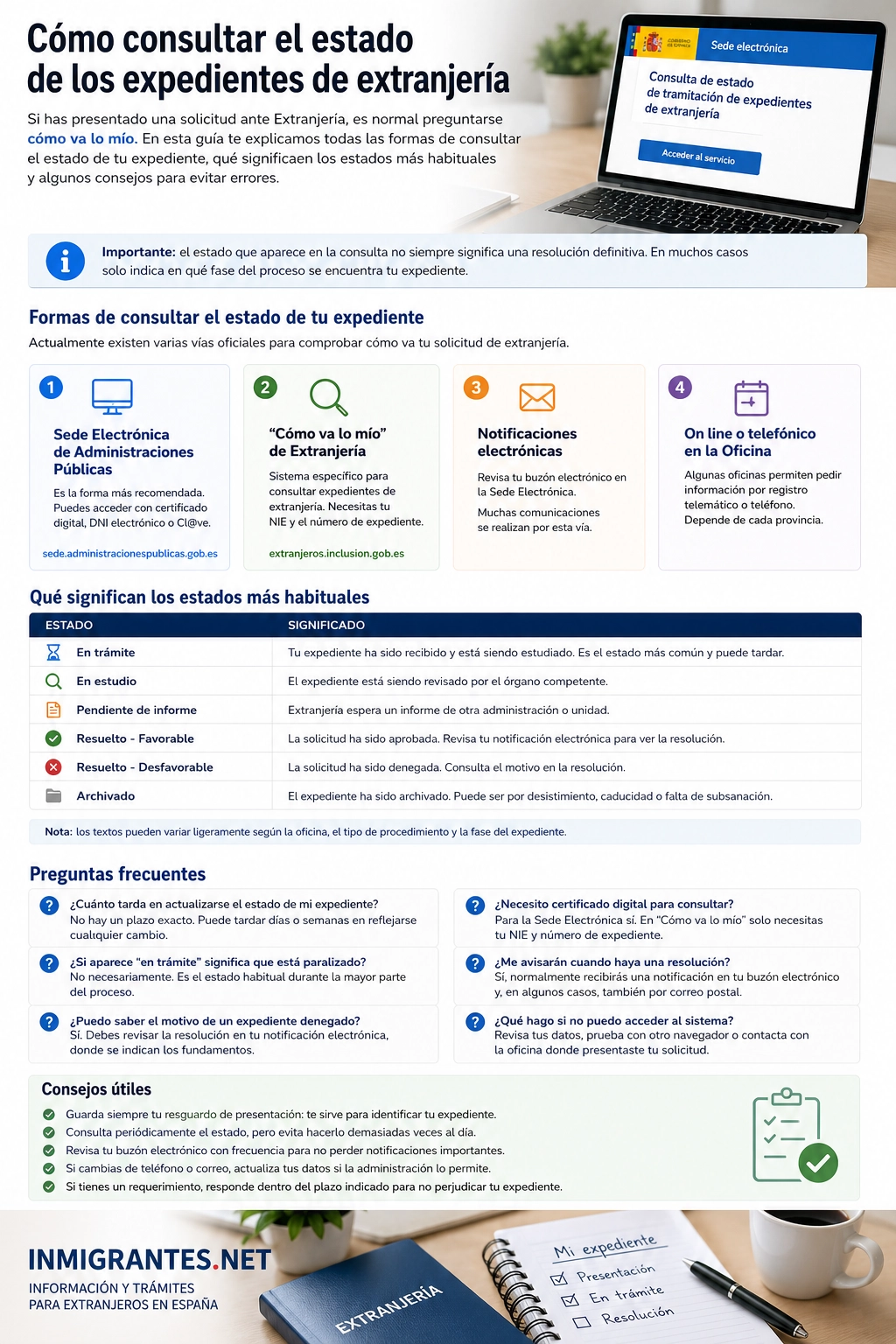
Infographic: checking the status of a Spanish immigration application
Infographic: checking the status of an immigration application

Frequently asked questions about checking immigration application status

How can I check the status of my immigration application?

You can check it online through the Government Administrations’ Electronic Office, using Cl@ve or a form; by SMS using your NIE or EXPE; or by phone using the number provided for application-status enquiries.

What information do I need to check my application status?

Depending on the method you use, you will usually need your NIE, application reference number, submission date, year of birth or an electronic identification system such as Cl@ve.

How do I check by SMS?

You can send an SMS with the word NIE followed by a space and your NIE, or with the word EXPE followed by a space and your application reference number. The application reference number must contain exactly 15 characters.

What does “in progress” mean?

It means the application is still awaiting review or a decision. No final decision has been made yet, so you should continue checking and look out for any notifications.

What does “additional documents required” mean?

It usually means the authorities need additional documents or clarification. Check the official notification and respond within the stated deadline.

What does “approved” mean?

It means your application has been approved. You should then check the official decision and see whether you need to book an appointment for fingerprinting, TIE issuance or another subsequent step.

What should I do if my application does not appear?

First, check that the details you entered are correct. If you have only just submitted your application, it may not yet have been entered into the system. If several days pass and it still does not appear, contact the relevant Immigration Office.

Is checking an immigration application the same as checking a citizenship application?

No. Immigration applications can be checked through the Government Administrations portal. Spanish citizenship applications based on residence are usually checked through the Ministry of Justice’s “Cómo va lo mío” system.

Final note: The status shown in the check is for information purposes only. To find out about deadlines, requests for additional documents, appeals or the actual effects of a decision, always check the official notification for your application.

Renewing your long-term residence card

Renewing a long-term residence card

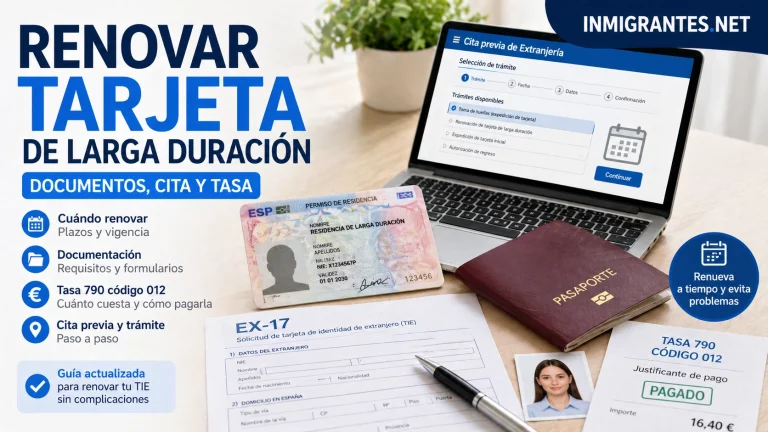
Renewing your long-term residence card is the procedure for updating your Foreigner Identity Card (TIE) when it is about to expire or has recently expired. It is important to distinguish between long-term residence authorization, which allows you to live and work in Spain indefinitely, and the physical card, which does need to be renewed periodically.

This guide explains clearly and practically when to renew your long-term residence card, which documents you need, what fee to pay, how to book an appointment, where to complete the procedure, and which mistakes to avoid.

Quick summary

Key points on renewing your long-term residence card

What you renewThe physical TIE, not the indefinite residence authorization.
When to renewWithin the 2 months before expiry or the 3 months after it.
Basic documentsPassport, TIE, EX-17, photo, Form 790, Code 012 fee, and an appointment.
Where to applyAt a National Police station or an authorized office, depending on your province.

Important: Do not confuse this procedure with an initial application for long-term residence. If you have already been granted long-term residence, you are usually renewing the physical card. Form EX-17 and the Form 790, Code 012 fee are generally used for this procedure.

[toc]

Renewing a long-term residence card
Renewing your long-term residence card

What it means to renew your long-term residence card

Long-term residence allows you to live and work in Spain indefinitely under conditions similar to those for Spanish citizens. However, the Foreigner Identity Card, known as the TIE, has an expiry date and must be renewed.

So, when we talk about renewing your long-term residence card, we are not usually talking about applying for residence from scratch, but about renewing the physical document that proves your legal status.

This is important because many people worry when they see that their card is expiring. Long-term residence authorization does not automatically lapse if you fail to renew the card by the deadline, although practical problems and possible penalties may arise if you do not meet the obligation to renew the document.

When to renew your long-term residence card

The long-term residence card must be renewed before it expires. It is advisable to start preparing for the procedure well in advance, especially because getting an appointment can be difficult in some provinces.

When What happens Recommendation
2 months before expiry This is the recommended period for applying for renewal. Book an appointment, pay the fee and prepare your documents.
Recently expired card You can still apply for renewal within the following 3 months. Act as soon as possible to avoid problems.
Expired for more than 3 months The authorization does not expire automatically, but you may encounter issues. Check your situation before travelling or carrying out important procedures.

Tip: Don’t wait until the last day. Although the procedure is relatively straightforward, getting an appointment, paying the fee, obtaining a photograph or completing your municipal registration can cause delays if you leave everything until the last minute.

How often does long-term residence need to be renewed?

As a general rule, the long-term residence card must be renewed every 5 years. However, under the current regulations, the card’s validity period may vary according to the holder’s age for the second and subsequent renewals.

First renewalApply 5 years after the first long-term residence card was issued.
Subsequent renewals before the age of 30Renew every 5 years until the holder turns 30.
Subsequent renewals at age 30 or olderThe card issued may be valid for 10 years.

Documents required to renew a long-term residence card

The documents usually required to renew a long-term residence card are simpler than those needed to renew a temporary residence permit. Even so, you should make sure everything is properly prepared.

Basic documentation

  • Completed and signed EX-17 form.
  • Valid, complete passport or travel document recognised as valid in Spain.
  • Previous Foreigner Identity Card (TIE), even if it is about to expire or has recently expired.
  • Recent photograph in colour, with a white background and passport-photo size.
  • Proof of payment of fee 790, Code 012.
  • Municipal registration certificate if you have changed address or the office requires it.

At your appointment, you may be asked to show original documents and provide copies. It is therefore advisable to bring your original passport, previous card, appointment confirmation and copies of the main documents.

Do you need to prove you have sufficient financial means or social security contributions?

For renewal of the physical card for long-term residence, you generally do not need to prove that you have sufficient financial means, an employment contract, a minimum level of social security contributions or health insurance as a primary requirement of the procedure.

This distinguishes it from many temporary residence renewals. The person already holds a recognised long-term residence authorization; therefore, the procedure focuses on renewing the document that proves this status.

Important: If you do not yet have long-term residence and want to apply for it for the first time, this is a different procedure, with different requirements, a Form 790, Code 052 fee and a different application form.

Which fee do you pay to renew your long-term residence card?

To renew your long-term residence card, you would normally use the Form 790, Code 012 fee, which is linked to police procedures for foreign nationals’ identity documents.

This fee should not be confused with the Form 790, Code 052 fee, which is used for other immigration procedures, or the Form 790, Code 026 fee, which is used for Spanish citizenship by residence.

Fee Common use Example
Code 790, Form 012 Police procedures for foreign nationals’ identity documents. Renewal of a long-term TIE.
Code 790, Form 052 Residence authorizations and other administrative procedures. Initial application for long-term residence, arraigo, authorizations or administrative renewals.
Code 790, Form 026 Procedures handled by the Ministry of Justice. Spanish citizenship by residence.

How to book an appointment to renew your long-term residence card

Renewing a long-term TIE usually requires an appointment at the police station or designated office in the province where you live. In the appointment booking system, the procedure may appear under names such as fingerprinting, card issuance, long-term card renewal, or a similar name, depending on the province.

Typical steps for booking an appointment

  1. Go to the official immigration appointment booking system.
  2. Select your province.
  3. Look for the procedure related to the police, fingerprinting or TIE issuance/renewal.
  4. Enter your personal details exactly as they appear on your card.
  5. Choose an available date and time.
  6. Save your appointment confirmation to bring with you on the day of the procedure.

If no appointments are available, do not book an appointment for a completely different procedure. It is better to check availability at other times or see whether your province provides specific instructions.

Where to renew your card

Renewals are normally handled at the Police Station or the designated foreign nationals’ documentation office for the applicant’s place of residence.

In some cases, official information may refer to Immigration Offices or police services. It is therefore essential to check your appointment confirmation, which will show the exact address, the procedure selected and the documents you need to bring.

Step-by-step guide to renewing your long-term residence card

  1. Check the expiry date on your current TIE.
  2. Book an appointment for the correct Police/Immigration procedure.
  3. Fill in form EX-17 with your up-to-date details.
  4. Pay the fee for form 790, code 012, and keep the receipt.
  5. Prepare your passport, previous card and photograph in the correct format.
  6. Attend the appointment in person with the originals and copies.
  7. Have your fingerprints taken if required.
  8. Collect your new card when it is ready, following the police station’s instructions.

Can I travel with an expired long-term residence card?

Travelling with an expired card can cause problems, especially when returning to Spain or going through border controls. Although long-term residence authorization does not automatically expire when the card does, the physical document is what proves your status to third parties.

If you need to travel and your card has expired or is being renewed, you may need a return authorization, especially if you are leaving Spain and do not yet have your new TIE.

Before travelling

  • Check your card’s expiry date.
  • Check whether you have proof of renewal or a receipt for your application.
  • Find out whether you need a return authorization.
  • Do not travel with only your expired card without first confirming your situation.

What happens if my long-term residence card has expired?

If your card has already expired, it is best to book an appointment and renew it as soon as possible. Applying within 3 months of the expiry date may extend the validity of your previous card until a decision is made on the procedure, although you may be subject to a penalty for applying after the deadline before expiry.

If more than 3 months have passed, this does not automatically mean that you have lost your long-term residence status, but you may have problems travelling, working, handling bank procedures, renewing documents or proving your legal status.

General guidance

Has your long-term residence card expired?

If you are unsure which appointment to book, which fee to pay or whether you can travel, check your situation before making a mistake.

Request an online consultation

Common mistakes when renewing a long-term residence card

Although the procedure may seem straightforward, some common mistakes can cause you to lose your appointment or delay the issue of your new card:

  • Booking an appointment for the wrong procedure.
  • Paying the wrong fee, for example, fee 052 instead of fee 012.
  • Bringing a photograph that does not meet the required format.
  • Attending without the completed EX-17 form.
  • Not bringing a valid passport.
  • Not providing proof of municipal registration if you have changed address.
  • Waiting until your card has been expired for months.
  • Trying to travel with an expired card without a return authorization when one may be required.

Frequently asked questions about renewing the long-term residence card

What is renewed: the residence authorization or the card?

For long-term residence, it is normally the Foreigner Identity Card (TIE)—the physical document—that is renewed. The long-term residence authorization allows you to live and work in Spain indefinitely.

When should I renew my long-term residence card?

You must submit your application during the 2 months before the card expires. You can also submit it within the 3 months after it expires, although applying outside the recommended period may result in penalties.

How often does the long-term residence card need to be renewed?

You apply for the first renewal after 5 years. Subsequent renewals are required every 5 years until the cardholder turns 30, and every 10 years thereafter, according to the current official information.

What documents do I need to renew the card?

You will normally need Form EX-17, a valid passport, your previous card, a recent colour photograph with a white background, proof of payment of the Form 790, Code 012 fee, and a municipal registration certificate if you have changed address or the office requires one.

What fee do I have to pay?

The fee normally used to renew a long-term residence card is Form 790, Code 012, which applies to police procedures for foreign nationals’ identity documents.

Do I need an employment contract or social security contributions?

An employment contract or a minimum level of social security contributions is not usually a key requirement for renewing the physical long-term residence card. This differs from many temporary residence renewals.

What happens if I do not renew the card within the deadline?

Failing to renew the card on time does not automatically terminate the long-term residence authorization, but it may cause practical problems and lead to possible penalties. It is advisable to renew it as soon as possible.

Can I travel with an expired card?

Travelling with an expired card may cause problems when you return to Spain. If you need to leave the country while your card is being renewed, check whether you need a return authorization.

Final note: renewing a long-term residence card is a document-related procedure, but it is still important to complete it correctly. Always check the appointment, form, fee and documents required by the relevant police station or office.

Mercurio system for immigration applications: practical guide

Mercurio system

The Mercurio system is the online platform of the Ministry of Inclusion, Social Security and Migration for submitting applications and renewing immigration authorizations in Spain. It allows you to complete most procedures without visiting an Immigration Office, provided you have a digital certificate or Cl@ve.

What is the Mercurio system?

Mercurio is the government online portal provided by the Ministry of Inclusion, Social Security and Migration for submitting residence and work authorization applications online. It was launched to replace the former system, which required applications to be submitted in person, and now allows most applications to be processed without travelling to an office.

It should not be confused with the Ministry of Foreign Affairs platform, which handles consular visas, or with the Central Civil Registry. Mercurio is specifically for Spanish immigration procedures carried out in Spain.

ℹ️

Important: Mercurio handles residence and work authorizations. To apply for a visa from abroad, you must contact the Spanish consulate in your country. To track citizenship applications, use the Central Civil Registry.

What procedures can you complete through Mercurio?

The platform covers both initial applications and renewals. These are the main ones:

Procedure Available through Mercurio Notes
Arraigo social (social-integration residence route) ✓ Yes Initial application and renewal
Arraigo laboral (former employment-related residence pathway) ✓ Yes Initial application and renewal
Arraigo familiar (family-based residence route) ✓ Yes Initial application and renewal
Family reunification ✓ Yes Initial application
Non-lucrative residence ✓ Yes Initial application and renewal
Residence for employment (employed work) ✓ Yes Submitted by the employer
Long-term residence (Spain and EU) ✓ Yes Initial application
Humanitarian grounds ~ Partial Depending on the type of circumstance
Immigration appointment ✗ No Managed through sede.administracion.gob.es

How do you access the Mercurio platform?

To use Mercurio, you need to identify yourself electronically. The system accepts the following methods:

🔐
Digital certificate

Issued by the FNMT or other recognised entities. This is the most common method for individuals.

🪪
Electronic DNI

Valid if you have a card reader and an activated chip. For Spanish citizens only.

🔑
Cl@ve PIN / permanent Cl@ve

The Government’s identification system. You must register in advance, either at an office or online.

Once you have identified yourself, access the online portal of the Ministry of Inclusion: extranjeros.inclusion.gob.es. From there, you will find direct access to Mercurio under online procedures.

⚠️

If you do not have a digital certificate: you can apply for one free of charge on the FNMT website. You will need to go in person to a registration office (Tax Agency, Social Security or municipal council) to verify your identity.

Steps for submitting an application through Mercurio

The process varies depending on the procedure, but generally follows these steps:

1
Log in and identify yourself

Access the online portal using your digital certificate, electronic DNI or Cl@ve. If you are acting on someone else’s behalf, you need a power of attorney.

2
Select the procedure

Choose the type of authorization that applies to your situation. If you are unsure, first consult the guide for each type of residence before starting.

3
Complete the EX form

Each procedure has its own form (EX-01, EX-03, EX-10, etc.). Errors in your personal details or NIE can delay or invalidate your application.

4
Attach the required documents

Upload the documents as PDFs. Each file must be no larger than 5 MB. Foreign documents must bear an apostille and be translated by a sworn translator.

5
Pay the fee (if applicable)

Some residence authorizations require payment of the Form 790 fee in advance. The platform is integrated with the Tax Agency for online payment.

6
Sign and submit

Sign electronically and submit your application. You will receive a filing receipt with an application reference number. Keep it to check your application status and for future procedures.

✅

Tip: Before submitting, download and save a copy of everything you attach. If the authorities request additional documents, you will also have to submit them through Mercurio, under the same application.

Residence permit renewal deadlines

Meeting renewal deadlines is essential to avoid losing your legal status in Spain.

Situation When to renew Consequence
Within the deadline Up to 60 days before expiry Regular status while your application is being processed
Grace period Up to 90 days after expiry Permitted, but may result in an administrative penalty
Outside the deadline More than 90 days after expiry Irregular immigration status: a new procedure is required
⚠️

Don’t wait until the last minute. During periods of high demand, you may have trouble accessing the platform. Ideally, start the process 3 months before expiry.

Do I need an immigration adviser or lawyer to use Mercurio?

It’s not mandatory, but it depends on your situation. If your case is straightforward (a renewal with no issues and complete documentation), you can manage it yourself. It’s advisable to seek professional advice if:

  • You have a criminal record or previous administrative penalty proceedings
  • Your application has previously been refused
  • Documents from your country of origin are difficult to have apostilled
  • You’re unsure which type of authorization applies to you
  • You need to appeal an administrative decision

Do you have questions about your application in Mercurio?

Our immigration lawyers can review your case and advise you before you submit your application.

Consult a lawyer →

How can I check my application status?

Once you have submitted your application, you can check its status in two ways:

💻
Through the Mercurio platform

Log in with your digital certificate and go to “My applications.” You will see the latest status, the documents you have submitted and whether any requests for additional documents are pending.

🔎
Using your application reference number

In some provinces, you can check the status by entering your application reference number on the Government Delegation’s website, without a digital certificate.

The system sends notifications to the registered email address. Check it regularly: requests for additional documents must be answered within 10 working days. If you do not reply by the deadline, your application may be archived.

Frequently asked questions about Mercurio

+
Can I use Mercurio without a digital certificate?
No. Access to Mercurio requires electronic identification: a digital certificate, DNI electrónico or Cl@ve. If you do not have any of these, you must apply for them before using the platform, or act through a representative who does have them.
+
My application was refused. What can I do?
You have the right to file an administrative appeal to a higher authority within one month of being notified of the refusal. If the appeal is also refused, you can seek judicial review before the administrative courts. In both cases, it is highly advisable to obtain specialist legal assistance.
+
How long does it take for an application to be decided?
The legal time limit is 3 months from the date of submission. If no response is received within that period, positive administrative silence applies. In practice, processing times vary by province: from 1 month to more than 6 months in areas with a higher volume of applications.
+
Do I book an appointment for immigration procedures through Mercurio?
No. Appointments at Immigration Offices are booked through the Ministry of the Interior’s government online portal (sede.administracion.gob.es), not through Mercurio. Appointments are for procedures that require you to be physically present, such as having your fingerprints taken for the TIE.
+
What happens if I make a mistake on a form I have already submitted?
Once you have submitted the application, you cannot amend the form. If the error is significant (incorrect personal details or an incorrect NIE), contact the Government Delegation in your province or wait for a request to provide missing or corrected documents. In serious cases, you may need to withdraw the application and submit it again.
+
What format should I use to upload documents?
The platform mainly accepts PDF. Each file must be no larger than 5 MB. If you have documents in other formats (images, Word files), convert them to PDF before uploading.

Madrid immigration office, April 2025: decision dates and information

The Madrid Immigration Office has recently published the expected decision dates for the most common procedures in April 2025. This information is crucial for anyone in the process of regularizing their immigration status in Spain. In this article, we will look at decision times, how to check application status, and other relevant aspects of immigration in Madrid.

How the Madrid Immigration Office is processing applications – October 2025

The Madrid Immigration Office has introduced various improvements to its services and decision-making processes this year. Waiting times have been a recurring concern, and measures have been adopted to reduce delays in deciding applications.

Since October 2025, significant progress has been made in processing applications, with a notable reduction in response times. This has been achieved through the digitalization of processes and the allocation of additional resources to meet demand.

Asylum seekers and people seeking work permits have noted that, although processing times remain variable, communication has become more transparent. Applicants are advised to stay informed about current dates and procedures.

Madrid immigration decision dates, April 2025

In April 2025, the Madrid Immigration Office set estimated decision dates for several procedures. These time frames are essential for applicants to plan their next steps.

  • Work permit renewals: 3 months.
  • Asylum applications: 6 months.
  • Citizenship applications: 12 months.
  • Dublin cases: 4 months.

It is important to note that these time frames are estimates and may vary depending on the office's workload. Applicants are therefore advised to check official channels regularly for updated information.

In addition, some individual cases may take longer because of the complexity of the application. Applicants should be prepared for possible requests for further information in these cases.

Estimated decision dates for immigration applications in Madrid

The estimated decision dates for immigration applications in Madrid are a useful guide for applicants. Knowing these time frames helps them manage their expectations and avoid uncertainty.

  1. Residence permits: They take approximately 4-6 months.
  2. Work permits: They are generally decided within 3-4 months.
  3. Asylum applications: They can take up to 12 months.
  4. Appeals: 6 months on average.

With this information, applicants can approach the Madrid Immigration Office with greater confidence, knowing that their applications are being processed within a reasonable timeframe.

How long are Spanish immigration procedures taking in Madrid?

Waiting times for Spanish immigration procedures in Madrid have been a constant concern. Currently, simpler procedures, such as residence permit renewals, are estimated to take between 2 and 4 months.

More complex procedures, such as asylum applications, may take considerably longer—more than 6 months in some cases. This has led many applicants to look for ways to speed up their cases.

Complaints about delays in processing applications have been common, prompting the office to make changes to improve matters. The key is to stay informed and make use of the resources the administration provides to the public.

What if I’m in another province?

Applicants who do not live in Madrid also have options for managing their applications. Although the Madrid Immigration Office is the busiest, every province has offices responsible for handling these procedures.

If you are in another province, it is advisable to contact the relevant local office to find out about specific processing times and procedures. In many cases, processing times may be shorter because there are fewer applications.

In addition, some offices may offer online assistance, making the process easier. Information about each office is available on the website of the Ministry of Inclusion, Social Security and Migration.

Will hiring a lawyer make it faster?

Hiring a lawyer specialising in Spanish immigration procedures may be a viable option for those looking to speed up their applications. A professional in this field can guide applicants through the bureaucracy and help them avoid common mistakes.

However, it is important to bear in mind that although a lawyer can provide advice and support, they cannot guarantee a faster decision. Processing times depend primarily on the workload of the Madrid Immigration Office.

Lawyers are often experienced in preparing documents and submitting appeals, which may increase the chances of a successful outcome. Therefore, if you can afford it, hiring one may be a worthwhile investment.

Related questions about Spanish immigration procedures

What are the processing dates for immigration applications in Madrid for 2025?

The processing dates for immigration applications in Madrid for 2025 vary depending on the type of procedure. For example, asylum applications can take up to 12 months, while work permit renewals are usually decided within 3 to 4 months.

Applicants should keep up to date with the dates published by the Madrid Immigration Office and regularly check official documents to avoid surprises.

How long are immigration decisions taking in Madrid?

Immigration decisions in Madrid are taking an average of 2 to 6 months, depending on the procedure. Simpler procedures, such as renewals, are faster than asylum applications, which can take considerably longer.

The authorities have been working to reduce these processing times, so it is advisable to stay informed through official announcements and follow updates on the website of the Ministry of Inclusion, Social Security and Migration.

When will I receive my immigration decision?

How long it takes to receive a decision on an immigration application depends on several factors, including the type of procedure. Applicants should generally receive notifications within the timeframes established when they submit their applications.

If you have not received an update within the specified timeframe, it is advisable to contact the Madrid Immigration Office or check your application status online using the available channels.

What is the deadline for a decision on an immigration application?

The deadline for a decision on an immigration application varies depending on the type of procedure. In general, the Madrid Immigration Office sets approximate timeframes ranging from 3 months for certain permits to 12 months for more complex applications, such as those for citizenship or asylum.

Applicants should keep an eye on updates to processing timeframes and any changes the office may announce, as these could affect how long the process takes.

Rights and freedoms of foreign nationals in Spain

In Spain, the rights and freedoms of foreign nationals are essential to ensuring integration and respect for the dignity of all people, regardless of nationality. Current legislation establishes a framework that not only protects immigrants but also encourages their participation in Spanish society.

Since Organic Law 4/2000 was passed, various rules and reforms have been introduced to ensure that foreign nationals in Spain can access fundamental rights, services and benefits, in line with European Union guidelines and the Universal Declaration of Human Rights.

What rights and freedoms do foreign nationals have in Spain?

The rights and freedoms of foreign nationals in Spain are guaranteed by national legislation and various international regulations. The main rights include:

  • The right to documentation and freedom of movement.
  • The right to education and healthcare.
  • The right to participate in political life, in certain cases.
  • Access to social services and basic benefits.

In addition, the fundamental rights of foreign nationals in Spain are aligned with international treaties that promote respect for human rights. This means that, regardless of their immigration status, foreign nationals have rights that the Spanish authorities must respect.

The social integration of immigrants in Spain is one of the pillars of the country's immigration policy. This is reflected in programmes that facilitate access to culture, education and employment.

What amendments have been made to Organic Law 4/2000?

Organic Law 4/2000 has been amended several times since it was passed, most recently in 2025. These amendments aim to adapt the law to social realities and the needs of immigrants in Spain.

The main amendments include:

  1. Improvements in immigrants' access to documentation.
  2. Simplification of administrative procedures relating to residence and work.
  3. Stronger safeguards for protecting the human rights of foreign nationals.

These amendments reflect the Spanish Government's commitment to ensuring that immigrants can fully integrate into society and receive the support they need for their well-being.

How does Royal Decree 1155/2024 affect foreign nationals in Spain?

Royal Decree 1155/2024 introduces new regulations that directly affect foreign nationals in Spain. This decree supplements Organic Law 4/2000 and focuses on immigration policy, aiming to improve the management of migration processes.

Some of the decree’s key points are:

  • Streamlining administrative procedures related to immigration.
  • Enhanced protection of the rights of immigrants in vulnerable situations.
  • Regulation of cooperation between public authorities to facilitate integration.

These measures aim not only to regulate the entry and stay of foreign nationals in Spain, but also to ensure that their rights are effectively respected, thereby promoting their social and economic integration.

What rights do immigrants have in Spain?

Immigrants in Spain have a range of rights that are essential to their well-being and integration into society. These include:

  1. The right to equality and non-discrimination.
  2. The right to healthcare and education.
  3. Access to justice and legal assistance.
  4. The right to participate in social and cultural life.

These rights are designed to ensure that all immigrants, regardless of their status, can enjoy a dignified life and have opportunities to fulfil their potential.

In addition, the rights and freedoms of immigrants in Spain are supported by various international organisations, reinforcing their importance and effective application in the country.

What are the principles of Spain’s migration policy?

Spain’s migration policy is based on principles that aim to promote a humanitarian and respectful approach towards immigrants. Some of these principles are:

  • Respect for the human rights and dignity of all immigrants.
  • Promoting social and cultural integration.
  • International cooperation in managing migration flows.

These principles are essential to ensure that migration policy focuses not only on regulating the entry of immigrants, but also on their settlement and well-being in Spanish society.

Immigration policy in Spain aims to build a more inclusive and respectful society where immigrants can contribute to the country’s development.

Where can I find the regulations implementing Organic Law 4/2000?

The regulations implementing Organic Law 4/2000 can be consulted on the website of the Government of Spain, where all current laws and regulations relating to immigration are published. They are also available on the public administration portal.

It is important to review these regulations, as they contain details about the procedures and specific rights of immigrants in Spain, as well as the obligations they must fulfil.

Additional resources are also available from non-governmental organisations that work with immigrants and offer guidance on navigating Spain’s legal and administrative system.

What social services and benefits can foreign nationals access?

Foreign nationals in Spain have access to a range of social services and benefits that are essential to their integration and well-being. These include:

  • Public healthcare.
  • Free education for minors.
  • Access to training and employment programmes.
  • Social assistance and integration programmes.

Access to these services depends on immigrants’ legal status, but the trend is towards greater inclusion and access, particularly in areas such as education and healthcare.

It is therefore essential for foreign nationals to know their rights and the services available so they can benefit from them fully.

Related questions about the rights of foreign nationals in Spain

What rights and freedoms do foreign nationals enjoy in Spain?

Foreign nationals in Spain enjoy fundamental rights, including access to education, healthcare and justice. They are also protected against discrimination and are entitled to documentation proving their legal status. These rights aim to ensure that immigrants are treated with dignity and respect.

What rights do I have as an immigrant?

As an immigrant in Spain, you have the right to equality before the law, to access healthcare and education services, and to take part in social activities. You can also apply for international protection if necessary and access legal assistance if you encounter problems with your immigration status.

Which foreign nationals are entitled to basic social services and benefits?

All foreign nationals who are legally resident in Spain are entitled to basic social services and benefits, such as medical care and public education. However, people without regular immigration status may have limited access to some services, although efforts are being made to ensure minimum care in critical areas.

What does the new immigration law propose?

The new immigration law proposes improving the management of migration flows, safeguarding immigrants’ human rights and facilitating their integration into society. It also focuses on simplifying administrative procedures for obtaining documentation and residence and work permits.

Applying for and renewing the red card in Barcelona

Obtaining and renewing the red card in Barcelona is an essential procedure for many foreign nationals seeking to regularize their immigration status in Spain. This document not only certifies their legal status but also allows them to access various public services.

In this article, we will explore the process of obtaining and renewing a red card in Barcelona, the requirements involved, and the importance of booking an appointment and providing the required documents.

How do you apply for or renew a red card in Barcelona?

To begin the process of obtaining and renewing a red card in Barcelona, it is essential to follow a few key steps. First, you need to determine whether you are making an initial application or renewing your card. In either case, you must attend the relevant Immigration Office, which you can easily locate on the National Police website.

It is also worth noting that the process has been simplified to make it easier for applicants to access services. To do this, we recommend booking an appointment for a red card in Barcelona through the website of the Ministry of Inclusion, Social Security and Migration.

Booking an appointment is a crucial step, as it ensures that applicants receive the assistance they need without long waits. It also enables staff to handle personal data appropriately and ensure that information is protected.

What are the requirements for renewing a red card in Barcelona?

The requirements for renewing a red card in Barcelona may vary depending on the applicant’s circumstances. However, certain documents are common to almost all cases. These include:

  • A duly completed application form.
  • Recent passport-sized photograph.
  • Documents proving international protection status.
  • Foreigner Identification Number (NIE).

It is essential to check whether any additional requirements apply to each applicant’s individual circumstances. We also recommend contacting the Immigration Commission or the ICAB for up-to-date information about the required documents.

Submitting all the required documents correctly is essential to avoid delays. If any documents are missing, the application may be refused, causing further difficulties for the applicant.

Where can you book an appointment to renew a red card in Barcelona?

To book an appointment for a red card in Barcelona, applicants must visit the website of the Ministry of Inclusion, Social Security and Migration. This portal allows you to book an appointment quickly and easily by choosing the nearest Immigration Office.

We also recommend choosing a convenient time to avoid crowds. Early mornings are usually quieter, which can make the process easier.

If applicants cannot attend their scheduled appointment, they must cancel it through the same portal so that the slot is available to others.

What documents do I need to renew the red card in Barcelona?

The documents required for the red card are one of the most important aspects to consider, as missing even one document can lead to the application being refused. Common documents include:

  1. Application form (EX-00) specifying the reason for the renewal.
  2. Photocopy of your NIE and passport.
  3. Documents proving international protection status.
  4. Proof of payment of the applicable fee.

It is advisable to organise these documents in advance and check that they are in order. Any error or missing document can cause problems with the renewal process.

We therefore recommend checking the National Police website and other official sources to make sure you have all the correct documents before attending your appointment.

When should I renew the red card in Barcelona?

You should renew the red card in good time to avoid legal problems. As a general rule, it is advisable to start the renewal process at least 60 days before your current card expires.

It is important to look out for notifications from the Ministry of Inclusion, as it may send reminders about your upcoming renewal. This can be especially helpful if you are busy with other aspects of your daily life.

It is also essential to be aware that waiting times may vary, as demand for appointments can fluctuate. Planning ahead is therefore essential.

What are the deadlines and fees for renewing the red card in Barcelona?

Deadlines and fees for renewing the red card in Barcelona may vary. As a general rule, however, the renewal fee is usually around 20 euros, although you should check the exact amount on the official website.

The authorities may take between 1 and 3 months to make a decision, depending on the number of applications and the Immigration Office. It is therefore crucial not to leave the process until the last minute.

Applicants also have the right to check the status of their application at any time. They can do so through the same portal used to book the appointment, which can provide peace of mind during the process.

Frequently asked questions about obtaining and renewing the red card in Barcelona

Where can I renew the red card in Barcelona?

You can renew the red card in Barcelona at designated Immigration Offices. Applicants should check which office is responsible for their area of residence. The National Police has several locations in the city where these procedures can be handled.

It is also worth bearing in mind that some police stations may offer better service than others, so we recommend reading reviews from other users. This can help you choose the most convenient option.

Finally, remember that you must book an appointment before going to the Immigration Office to ensure your application is dealt with at the appropriate time.

How do you renew the asylum red card?

The process for renewing the asylum red card is similar to that for the standard red card. First, applicants must complete the renewal form, which is available online or at the Immigration Office.

They must then gather the required documents, including the form, photographs and certificates proving their current situation. It is essential that all documents are up to date and in order to avoid complications.

Finally, you must book an appointment and attend at the scheduled time to submit your documents and complete the renewal process.

What should I bring to renew the red card?

When attending your red card renewal appointment, you must bring all the required documents. These include:

  • The duly completed application form.
  • Recent passport-sized photographs.
  • A copy of your NIE and passport.
  • Proof of payment of the fee.

Make sure you check that you have all the documents before leaving home. It may also be helpful to bring copies in case they are needed.

What is the best time to book an appointment at the Immigration Office?

The best time to book an appointment at the Immigration Office is usually early in the morning, between 9 and 10. Demand tends to be lower during these hours, which may mean shorter waiting times.

If you cannot go in the morning, it is best to avoid peak hours in the afternoon. You can also try to book an appointment on less busy days, such as early in the week.

Keeping track of the different opening hours and planning ahead are key to a smoother process when obtaining or renewing the red card in Barcelona.

Application for a residence authorization

Applying for a residence authorization is an essential process for those wishing to live and work in Spain. This procedure is handled by the Ministry of Inclusion, Social Security and Migration and is intended for foreign nationals who meet certain requirements.

This article explores the key aspects of this procedure, including how to apply, waiting times, the required documents and much more.

What is an application for a residence authorization?

Applying for a residence authorization is a legal procedure that allows foreign nationals to settle in Spain for a specified period. There are different types of authorization, depending on the applicant’s circumstances, such as temporary residence or long-term residence.

This authorization also includes the right to work in Spain, making it an essential document for anyone seeking employment opportunities in the country. In some cases, these authorizations are granted on humanitarian or national security grounds, for example to people who cooperate with the police or judicial authorities.

A residence authorization can be renewed and, in certain cases, changed to a long-term residence authorization, which offers the applicant greater stability and rights.

How do you apply for a residence authorization?

Applying for a residence authorization involves following a specific process, which may vary depending on the type of residence authorization being requested. The process generally includes:

  • Completing the relevant form, usually Form EX11 or EX17, depending on the applicant’s circumstances.
  • Paying the applicable application fees, which must be paid for the application to be processed.
  • Submitting the required documents to the immigration unit of the police or the relevant government delegation.

It is also possible to complete this procedure online through the Ministry’s government online portal, making the process easier and avoiding the need to attend in person.

Applicants who choose the online option must have a digital certificate, which is essential for authenticating the application.

How long does it take to process an application for a residence authorization?

The processing time for an application for a residence authorization may vary. The wait is generally between one and three months, depending on factors such as the administration’s workload and the complexity of the case.

Once the application has been submitted, the applicant will receive a receipt confirming that it has been filed and allowing them to check its status. Applicants are advised to use the Ministry’s government online portal to keep track of the application’s progress.

In some cases, particularly applications for authorization on exceptional grounds, the response may take longer. This may happen if additional information is required or if the case is under review.

What documents are required to apply for a residence authorization?

The documents required to apply for a residence authorization vary depending on the type of authorization being requested. However, some commonly required documents include:

  1. Form EX11 or EX17, depending on the type of authorization.
  2. A photocopy of a valid passport.
  3. Proof of payment of the fees.
  4. Documents proving the circumstances that justify the application (for example, an employment contract).

It is essential to ensure that all documents are complete and up to date to avoid delays in the process. If you have any questions, we recommend contacting the relevant government delegation or checking the Ministry’s government online portal directly.

Who can apply for temporary residence authorization on exceptional grounds?

The temporary residence authorization on exceptional grounds is intended for certain groups of people in special circumstances. These include:

  • Foreign nationals who cooperate with the authorities in police or judicial investigations.
  • People who can prove that their safety is at risk.
  • Individuals with humanitarian reasons recognized by the competent authorities.

This type of authorization is normally granted for one year and may be renewed annually. If the cooperation is effective, long-term residence authorization may be granted after several years.

What are the requirements for renewing a residence authorization?

Renewing a residence authorization in Spain requires meeting certain conditions. Some of the most important are:

  • Demonstrating that the requirements of the previous authorization have been met.
  • Submitting the required documents on time, before the authorization expires.
  • Pay the fees for the renewal.

It is essential to start the renewal process at least 60 days before the authorization expires. This allows enough time to resolve any issues that may arise during the process.

The first renewal is usually more straightforward, but every case is different and additional documents may be required depending on the applicant’s specific circumstances.

Related questions about applying for a residence authorization

How long does a residence authorization take?

The processing time for a residence authorization can vary, but the process generally takes between one and three months. This depends on the type of residence authorization requested and the workload at the Immigration Offices. It is important to check the application status through the Ministry’s government online portal.

How do you apply for a residence permit?

To apply for a residence permit, you must complete the relevant form and submit the required documents. You can do this in person at the immigration units or through the Ministry’s government online portal, where applicants need a digital certificate to authenticate their application.

What is Form EX17?

Form EX17 is a specific document used to apply for residence authorization in Spain on exceptional grounds. The form includes information about the applicant and the reasons justifying the application. It is essential to complete it accurately to avoid delays in the process.

How do you fill in Form EX11?

Form EX11 is used to apply for residence and work authorization. To complete it correctly, follow the instructions provided on the form and make sure to include all the requested information. We recommend checking that all the details are correct and that the supporting documents are complete to facilitate processing.

Updated immigration information sheets

Immigration information sheets are key resources that have been updated in line with the new regulations in force since May 2025. These sheets are designed to provide people with accurate information about Spanish immigration procedures. It is essential to understand the changes that have been introduced and how they can make it easier to manage various permits and authorizations.

As new regulations are introduced, it is essential for those concerned to stay informed about relevant updates. In this article, we will take an in-depth look at the new information sheets and their importance within the administrative framework.

What are immigration information sheets?

Immigration information sheets are documents prepared by the Ministry of Inclusion, Social Security and Migration that provide detailed information about procedures and requirements for various immigration-related matters. They are intended to ensure that both foreign nationals and legal professionals have the information they need to complete procedures efficiently.

Since being updated, the sheets have included information on residence permits, authorizations to stay and family reunification, among other relevant topics. The clarity and accessibility of these documents are crucial to helping people understand the regulations in force and the related procedures.

The sheets are also designed to meet the needs of different groups of foreign nationals, including those seeking work, study or family reunification. This ensures that everyone can access the information they need for their particular circumstances.

Which immigration information sheets have been updated for 2025?

The updated immigration information sheets for 2025 cover a wide range of topics that are essential for anyone wishing to live in Spain. These include, but are not limited to:

  • Residence permits for employment.
  • Authorizations for study and internships.
  • Family reunification and the requirements involved.
  • Residence permits on humanitarian grounds.
  • Documents required for highly qualified foreign nationals.

Each sheet is designed to provide clear, concise information about the applicable procedures, requirements and time limits. The latest changes focus on adding new procedures and simplifying some administrative processes, which benefits applicants.

Information resources on mobility within the European Union have also been added, helping professionals better understand their rights and opportunities in the European context.

How can I access immigration information sheets in PDF format?

To access the immigration information sheets, those concerned can visit the official website of the Ministry of Inclusion, Social Security and Migration. There, they can access all the sheets in PDF format, which are free to download.

The process is straightforward. Users should follow these steps:

  1. Visit the Ministry of Inclusion website.
  2. Go to the immigration section.
  3. Select “Information sheets” to view the available list.
  4. Choose the information sheet you need and click the download link.

This accessibility ensures that citizens and foreign nationals alike have the information they need to complete their procedures correctly. The PDF format also makes the information easy to consult and store on personal devices.

What new procedures are included in the immigration information sheets?

With the new immigration regulations coming into force, several new procedures have been introduced that are relevant to permit applicants. These include:

  • Improvements to family reunification procedures, simplifying the required documentation.
  • Streamlined procedures for obtaining authorizations to stay.
  • New types of residence permits for study purposes.
  • Clearer deadlines for responding to applications.

These changes not only make the processes easier to understand but also aim to reduce waiting times in public administration. The information sheets have been updated to reflect the Ministry’s commitment to improving the applicant experience.

The new procedures also focus on including vulnerable groups, ensuring that additional support is provided to those who need it most, such as victims of gender-based violence.

Why are information sheets important for administrative procedures?

The immigration information sheets are an essential administrative resource, providing detailed, up-to-date information about Spanish immigration procedures. This information is vital to ensure applicants meet all the necessary requirements and can complete their procedures effectively.

One of the main benefits of these sheets is that they help applicants avoid common mistakes that could delay their procedures. Clear details about the required documents and the steps to follow help reduce uncertainty and improve the chances of success.

The information sheets are also available in PDF format, making them easy to share and helping ensure that anyone who may need them, such as legal advisers or applicants’ family members, can access the information.

How do immigration information sheets make permit applications easier to manage?

The immigration information sheets are practical tools that make it easier to manage residence permits and other administrative procedures. By providing specific information about requirements and processes, they help applicants navigate the bureaucracy with a better understanding of what to expect.

These sheets are particularly useful in the following areas:

  • Clear requirements: The information sheets specify exactly which documents are needed for each procedure.
  • Guidance on deadlines: They inform applicants about processing times and deadlines to meet.
  • Access to resources: They provide useful links and contact details for obtaining additional assistance if needed.

Efficient permit processing is essential to improving the experience of foreign nationals in Spain, and the information sheets play a key role in this process.

Related questions about immigration information sheets

Where can I find the immigration information sheets?

You can find the immigration information sheets on the official website of the Ministry of Inclusion, Social Security and Migration. This portal is the most reliable source for up-to-date information about procedures and requirements.

Once on the website, go to the section dedicated to immigration, where you will find a list of information sheets available to download.

Which procedures are covered by the immigration information sheets?

The information sheets cover a range of Spanish immigration procedures, including residence permits, authorizations to stay and family reunification. Each sheet focuses on a specific topic and explains the relevant requirements and procedures.

This allows users to find information tailored to their specific needs and manage their administrative procedures efficiently.

How can you download the immigration information sheets?

The information sheets are available to download in PDF format from the Ministry of Inclusion’s website. Simply select the sheet you are interested in and click the download link. The process is free and available to everyone.

When does the new immigration regulation come into force?

The new immigration regulation came into force in May 2025. Since then, the information sheets have been updated several times to ensure that people have access to the most recent and accurate regulations.

Who are the immigration information sheets for?

The immigration information sheets are intended for all foreign nationals who live in or wish to live in Spain, as well as professionals working in the field of immigration. They are especially useful for anyone seeking to better understand the procedures involved in residence permits and other administrative matters.

Their inclusive design ensures that anyone interested can access the information they need to manage their procedures appropriately.

New immigration fees 2025: updated information

The new Spanish immigration fees 2025 are an important consideration for anyone wishing to complete immigration procedures in Spain. These fees have been updated and regulated to facilitate the process of obtaining residence authorizations and identity cards, with a focus on transparency and legal certainty.

The new fees will come into effect on 16 June 2025, replacing the previous ones. Foreign nationals should familiarise themselves with the fees applicable to their procedure to avoid any difficulties.

What are the new Spanish immigration fees 2025?

The new Spanish immigration fees 2025 refer to the amounts set for various immigration procedures in Spain, as governed by Organic Law 4/2000 and Royal Decree 1155/2024. These fees apply to applications for residence authorizations, extensions of stays and other related procedures.

The main purpose of these fees is to facilitate the collection and administration of fees for immigration procedures. Their implementation is expected to make the administrative process more transparent.

  • Residence authorizations.
  • Extensions of stay.
  • Identity cards.
  • Citizenship procedures.

The amounts vary depending on the type of procedure requested, so applicants should consult the up-to-date fee table for each type of procedure.

When do the new immigration fees come into effect?

The new Spanish immigration fees 2025 will come into effect on 16 June 2025. This date is crucial for anyone who needs to complete immigration procedures in Spain. Anyone affected is advised to prepare in advance to avoid any problems.

From this date, the previous fees will no longer be valid and only the new fees will apply. This means that all applications submitted after this date must comply with the new fees.

It is important to remember that procedures must follow their usual course, so applicants should keep track of the dates and deadlines set by the competent authorities.

How much does each immigration procedure cost in 2025?

The cost of each immigration procedure in 2025 varies depending on the type of procedure. The new Spanish immigration fees 2025 are designed to be more affordable and better reflect the administrative costs associated with each type of application.

  1. Extension of stay: 30 euros.
  2. Temporary residence application: 60 euros.
  3. Foreigner Identity Card (TIE): 15 euros.
  4. Spanish citizenship: 100 euros.

Applicants should consult the full list of fees, which will be published on the official website of the Ministry of the Interior and other relevant bodies. Each procedure may have different costs depending on the type of residence or authorization being sought.

Who is exempt from this new immigration fee?

Not everyone is required to pay the new immigration fees 2025. Certain exemptions and benefits may apply to specific groups. For example, people under 18 or those in vulnerable situations may be exempt from payment.

In addition, some procedures related to international protection may not require payment of a fee. Applicants are advised to consult a lawyer or immigration specialist to find out whether they qualify for an exemption.

  • Minors.
  • Victims of gender-based violence.
  • Asylum seekers.

Being aware of these exemptions can lead to significant savings for people in specific situations. Legal advice can provide greater clarity about possible exemptions.

How do you pay the immigration fee in 2025?

The new immigration fees 2025 can be paid using various methods, making the process easier for applicants. In general, payments can be made online through the Ministry of Foreign Affairs’ electronic office or at authorised banks.

To pay, applicants must complete Form 790, the specific form used to pay immigration fees. It can be downloaded from the official website and must be submitted with the relevant application.

It is essential to keep the payment receipt, as it will need to be submitted while the application is being processed. Applicants are also advised to pay well in advance of submitting their application to avoid delays.

What exemptions and benefits are available for fee payments?

The new immigration fees 2025 include several exemptions and benefits that may be helpful to certain groups. For example, fee reductions have been introduced for large families and people in difficult financial circumstances.

  1. Exemption for people under 18.
  2. Reduction for large families.
  3. Exemptions for people in vulnerable situations.

In addition, some applications, such as those related to international protection, may not require payment of a fee. It is advisable to find out about these benefits, as they may significantly facilitate the process of regularising immigration status.

Where can you find information about the new immigration fees 2025?

For up-to-date information about the new immigration fees 2025, people can visit the official website of the Ministry of the Interior and other relevant bodies. These websites provide details about procedures, updated costs and any recent changes to the regulations.

It is also advisable to enquire directly at offices of the National Police or the Directorate-General for Migration, where you can receive personalised guidance on the specific procedures you wish to complete.

It is essential to stay informed about developments and changes in immigration law, as these may directly affect procedures and their associated costs.

Frequently asked questions about the new immigration fees 2025

When will the new immigration fees be introduced?

The new immigration fees 2025 will be introduced on 16 June 2025, replacing the previous fees. Applicants should prepare for this date, as all applications submitted after it will be subject to the new fees.

Applicants are therefore advised to start gathering the required documents and find out about the updated costs before undertaking any procedure.

How much is the 790 012 fee in Madrid in 2025?

The 790 012 fee, used for various immigration procedures, will vary depending on the type of procedure. Although the exact amounts will be determined when the new fees come into force, they are expected to remain affordable for applicants.

Applicants should consult the fee table to be published on the official website of the Ministry of Foreign Affairs for precise information about the cost of this fee in Madrid and other regions.

What is Spain’s new immigration reform in 2025?

The new immigration reform in Spain in 2025 will focus on simplifying immigration procedures and updating immigration fees. The aim of this reform is to improve immigrants’ integration and make it easier for them to access public services.

It also seeks to ensure greater protection of immigrants’ rights, including reviewing fees and removing obstacles that could make it harder to regularize their immigration status.

What is the immigration fee for long-term residence in Spain?

The immigration fee for long-term residence in Spain will be set as part of the new immigration fees for 2025. Although the exact amount will be published closer to the effective date, it is expected to reinforce the Spanish Government’s commitment to a fairer and more accessible immigration policy.

Applicants should stay informed and check the Spanish Ministry of the Interior’s official website regularly for updates, where detailed information about these procedures will be published.

A new life in Spain without regular immigration status: challenges and opportunities

In Spain, more than half a million immigrants live without documentation, facing challenging circumstances. A new life without regular immigration status in Spain is characterized by insecurity, a constant search for opportunities, and the struggle to regularize their status.

This article explores the realities these people face, their challenges, and the opportunities they may find to integrate into Spanish society.

What is it like to live in Spain without regular immigration status?

Life for an immigrant without regular immigration status in Spain is complex and difficult. Many of them, such as Grias Uddin and Ana Julieta Vallejo, face job insecurity and a lack of access to basic services every day. Insecurity becomes their constant companion.

Fear of deportation and social exclusion shape the experience of living without regular immigration status. Living in the shadows affects not only their emotional well-being, but also their ability to work and support their families.

In addition, a lack of documentation limits their access to healthcare and education, further worsening their situation. The stories of people like Luis, a Venezuelan immigrant, reveal the daily struggle to survive within a system that marginalizes them.

What challenges do immigrants without regular immigration status face in Spain?

Immigrants without regular immigration status face many challenges in their daily lives. The most significant include:

  • Limited access to public services: Many cannot access adequate healthcare, posing a significant risk to their health.
  • Job insecurity: The jobs they find are often in the informal economy, where they have no employment rights and earn very low wages.
  • Limited opportunities to regularize their status: The complexity of Spain’s legal system makes it difficult to regularize their immigration status.

In addition, social stigma and discrimination can make integration even more difficult. Negative perceptions of immigrants without regular immigration status contribute to their isolation and vulnerability.

Finally, lack of information about their rights and available resources is a significant obstacle on the path to regularizing their status. Many are unaware of the options available to improve their situation.

What opportunities are there to regularize your immigration status in Spain?

Despite the many challenges, there are opportunities that may help immigrants without regular immigration status in Spain regularize their status. The Regularization Bill Initiative (ILP), backed by more than 600,000 signatures, aims to provide a solution to this problem.

The options for regularizing immigration status include:

  1. Stable employment: If they can find a job that meets certain requirements, they may be able to apply for regularization.
  2. Evidence of ties to Spain: Demonstrate ties to Spanish society, such as having lived in the country for a specific period or living with family members.
  3. Legal advice: Organisations such as GRIAS offer support to guide immigrants through the regularization process.

Social and political support is crucial to making these opportunities a reality. Public pressure to recognise immigrants’ rights is growing, which could lead to significant changes in immigration policies.

How can you work in Spain without papers while seeking to regularize your immigration status?

Working in Spain without papers is a constant challenge, but many immigrants find ways to survive while seeking to regularize their immigration status. Most work in the informal economy, doing jobs that are not always visible to the system.

It is important to note that although working without papers is risky, some sectors tend to employ immigrants without documentation, such as agriculture and construction. However, this entails a number of risks:

  • Labour exploitation: Without labour rights, many workers are subjected to abuse by employers.
  • Lack of stability: Jobs in the informal economy are often unstable and poorly paid.
  • Risk of detention: The possibility of being detected by immigration authorities is a constant concern.

For those seeking to regularize their immigration status, it is essential to keep a low profile and avoid situations that could attract the authorities’ attention. Seeking information and support from specialised organisations can also be crucial to navigating this complicated process.

What rights do immigrants without papers have in Spain?

Despite their situation, immigrants without papers in Spain have certain rights that must be respected. These include:

  • Right to education: All children have the right to receive an education, regardless of their immigration status.
  • Right to healthcare: They have the right to receive basic healthcare, although access can be difficult.
  • Right to protection from exploitation: The authorities must ensure they are not subjected to labour abuse.

It is essential for immigrants to know their rights so they can defend themselves and seek support when necessary. Lack of information is one of the main barriers they face in their struggle for dignity and integration.

What resources and support are available to immigrants in Spain?

Various organisations and resources are available to help immigrants without papers in Spain. Some of the most relevant include:

  • GRIAS: This organisation provides immigrants with legal advice and support, helping them through the regularization process.
  • NGOs such as the Red Cross: They provide social assistance and basic resources to people in vulnerable situations.
  • Community resource centres: They offer training and employability workshops, helping people integrate into society.

The community also plays a vital role in supporting immigrants. Help from neighbours and friends can be crucial in helping them find work and feel less isolated in their new life.

Related questions about the new life of someone without papers in Spain

How long can someone stay in Spain without papers?

A person can stay in Spain without papers indefinitely, although their situation is extremely precarious. There is no specific time limit, but the lack of documentation can lead to legal problems and the possibility of deportation at any time.

The situation becomes more critical if these individuals are detected by the authorities. For this reason, many choose to remain anonymous and live underground to avoid problems.

What is the new law for immigrants in Spain 2025?

The new law for immigrants in Spain expected in 2025 aims to improve immigrants’ conditions and facilitate the regularization of their immigration status. Although the details have not yet been finalised, the law is expected to include measures to protect the rights of immigrants without papers and promote their social and professional integration.

Activists and organisations are working to ensure that this law reflects immigrants’ needs and addresses issues such as labour exploitation and lack of access to basic services.

How can I live in Spain without papers?

Living in Spain without regular immigration status is challenging and is not recommended because of the risks and difficulties involved. However, some people choose to do so because they have no other options. For those in this situation, it is crucial to navigate carefully and avoid drawing the authorities’ attention.

In addition, seeking support from organizations that work with migrants can be a good way to stay informed about your rights and the resources available.

What rights do people without regular immigration status have in Spain?

People without regular immigration status in Spain have certain fundamental rights, such as access to education and healthcare. However, a lack of documentation can make it difficult to exercise these rights.

It is vital for anyone in this situation to find out about their rights and seek legal support when necessary so they can defend themselves against any abuse or injustice.

Application for a Foreigner Identity Card (TIE) (LO 4/ …)

Applying for a Foreigner Identity Card (TIE) is an essential process for foreign nationals who wish to live in Spain for periods longer than 180 days. This document not only confirms their legal status in the country but is also required for various administrative procedures.

Knowing the requirements, application process and necessary documents is essential to avoid problems. In this article, we explain everything you need to know about the TIE and why it matters to foreign nationals living in Spain.

What is the Foreigner Identity Card (TIE)?

The Foreigner Identity Card (TIE) is a document that confirms a foreign national's legal status in Spain. It is essential for people living in the country, as it allows them to carry out everyday activities such as opening a bank account or accessing healthcare services.

It is important to note that the TIE is issued not only to people with a residence permit but also to those with a student or work visa. The card is valid for a set period and must be renewed according to the applicant's circumstances.

The main purpose of the TIE is to help foreign nationals integrate into Spanish society by providing security and legal recognition. Having one helps avoid the risk of irregular situations that could lead to legal problems.

What are the requirements for applying for a Foreigner Identity Card (TIE)?

To submit an application for a Foreigner Identity Card (TIE), you must meet certain requirements. These may vary depending on the type of residence permit or visa concerned.

  • A valid passport.
  • Documents proving the reason for your stay (studies, work, etc.).
  • A municipal registration certificate showing that you live in Spain.
  • Completed Form EX-17.
  • Proof of payment of the applicable fee.

You must also provide a recent photograph and meet additional requirements if you are renewing your card. For example, if you are a student, you must submit documents proving your enrolment at an educational institution.

Gathering all the required documents helps ensure that the application process goes smoothly. Missing any of these requirements may delay your TIE.

How do you apply for a Foreigner Identity Card (TIE)?

Applying for a Foreigner Identity Card (TIE) is straightforward, but requires attention to detail. First, you must book an appointment at your nearest Immigration Office, as applications are not accepted without an appointment.

Once you have an appointment, you must submit the required documents. These include Form EX-17, which you can download online or obtain from the relevant office. It is essential to complete it correctly to avoid problems during the review.

  1. Book an appointment at the Immigration Office.
  2. Prepare the required documents.
  3. Attend your appointment and submit the documents.
  4. Collect your TIE within the established timeframe.

Remember to keep up to date with the current regulations and any changes to the procedures, as these may affect how you submit your application. For example, some offices allow you to start the process online, making it easier.

Where can you get Form EX-17 for a TIE application?

Form EX-17 is an essential document for the Application for a Foreigner Identity Card (TIE). You can obtain it in several ways. One option is to download it directly from the website of the Ministry of Inclusion, Social Security and Migration, which provides all the forms related to Spanish immigration procedures.

You can also request it at an Immigration Office when booking your appointment. It is advisable to check that you have the latest version, as forms are updated frequently.

Remember that it is essential to complete the form correctly to avoid errors that could delay your application. If you have any questions, you can visit an office and ask for guidance on how to fill in Form EX-17.

Why is the Foreigner Identity Card (TIE) important?

The Foreigner Identity Card (TIE) is an important document for foreign nationals in Spain, as it gives them access to a range of rights and services. Without a TIE, they may face difficulties in everyday life, such as being unable to work or access appropriate healthcare.

The TIE is also essential for those who wish to regularize their immigration status. It not only makes identification easier but also provides legal security, allowing foreign nationals to live and work in Spain without fear of deportation.

For students, the TIE is essential for living legally in Spain while pursuing their studies. It gives them the opportunity to integrate more easily into Spanish society and access a range of academic and social resources.

What should you do after obtaining your Foreigner Identity Card (TIE)?

Once you have obtained your Foreigner Identity Card (TIE), there are several steps you should take to ensure your stay in Spain goes as smoothly as possible. First, check your TIE’s expiry date, as you will need to renew it before it expires.

Also, make sure your details in the municipal registration (empadronamiento) are up to date. This is essential to avoid legal problems and ensure your information in the system is correct. You must notify the local authorities of any change of address or personal circumstances.

  • Check the TIE’s expiry date.
  • Keep your personal information in the register up to date.
  • Find out about the deadlines and requirements for renewal.
  • Access the available medical and social services.

Finally, remember to watch for any changes in the law that may affect your status or rights in Spain. Keeping informed will help you avoid problems and make the most of your stay.

Frequently asked questions about applying for a Foreigner Identity Card (TIE)

How do I apply for a TIE card?

To apply for your TIE card, you must follow a process that starts with booking an appointment at the Immigration Office. You must bring all the required documents, including Form EX-17. Submit all the required information on the day of your appointment and make sure you meet all the requirements.

Your application will be registered and, after a certain period, you will be able to collect your TIE from the same office. It is important to check your application status and meet the established deadlines.

How do you apply for a Foreigner Identity Card?

You apply for a Foreigner Identity Card using Form EX-17, which you must complete and submit to the Immigration Office. You must book an appointment and bring all the required documents proving your legal status in Spain.

Remember that submitting the documents and information correctly is key to avoiding refusal of your application. You should also find out about the fees payable during this process.

What are the requirements for applying for a TIE?

To apply for a TIE, you need a valid passport, Form EX-17, documents explaining the reason for your stay in Spain, and proof that you have paid the relevant fee. The list of documents may vary depending on the type of residence you are applying for.

It is essential to carefully check the specific requirements that apply to your situation to avoid any surprises when you apply.

What does the Foreigner Identity Card (TIE) mean?

The Foreigner Identity Card (TIE) is an official document that certifies a foreign national’s lawful stay in Spain. This document is essential for people living in the country, as it allows them to access basic rights and services and prove their legal status to the authorities.

The TIE is also essential for completing various administrative procedures, making it a fundamental part of life for foreign nationals in Spain.

Online consultation with a lawyer Get answers to your immigration questions