NIE to DNI identity matching certificate: what it is, what it is for and how to apply
Before starting the procedure: requirements and procedures may change. Check the information applicable to your case and consult the relevant official sources.
Practical guide
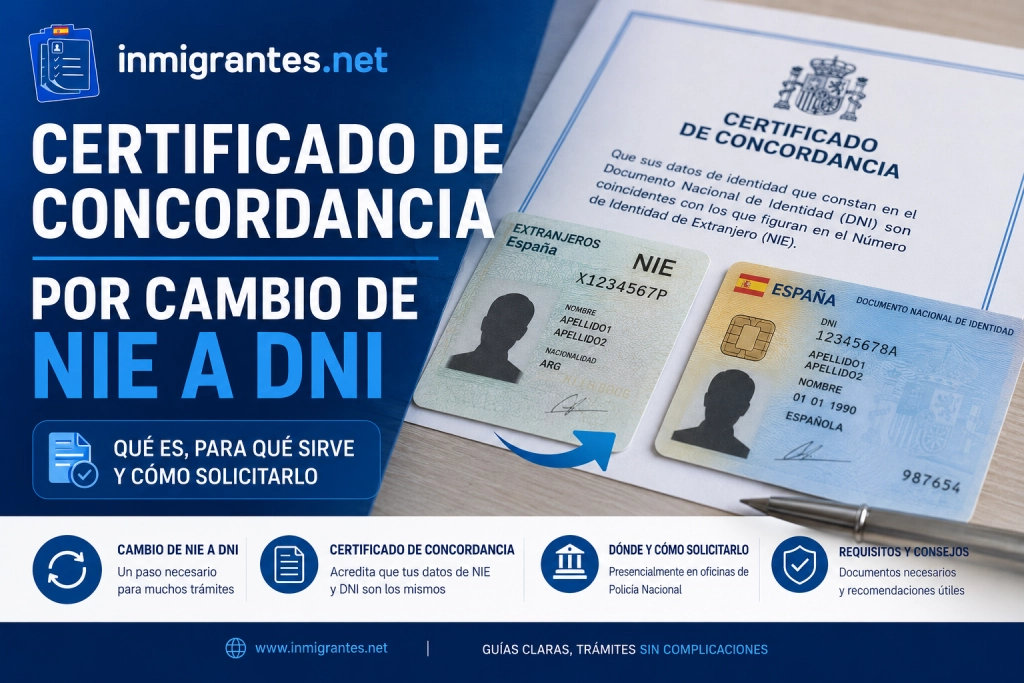
The identity matching certificate is a document confirming that the same person has switched from being identified by a NIE to being identified by a DNI. It is often essential for updating records with banks, universities, employers, Social Security or administrative authorities.
When a foreign national acquires Spanish citizenship, one of the most significant changes is that they are no longer identified solely by their NIE and are issued a Spanish DNI. Although the change may be obvious to you, many government departments, companies and organisations still have your details linked to your former number. This is where the NIE to DNI identity matching certificate comes in.
This document officially confirms that both identification numbers belong to the same person. In this guide, we explain what it is, what it is for, when you may be asked for it and how to apply for it, step by step.
What is the identity matching certificate?
The identity matching certificate is an official document normally issued by the National Police confirming the link between your former NIE and your new DNI. In other words, it certifies that these are not two different people, but the same person with a new form of identification after acquiring Spanish citizenship.
Its main purpose is to prevent errors, blocks or other issues when updating procedures, records and contracts that still show your NIE number.
What is the identity matching certificate for?
Although you will not always be asked for it, in practice it is a very useful document and, in many cases, almost essential. It serves to confirm the change in your identification to public and private organisations.
- Update your details with banks and financial institutions.
- Update your identification details with Social Security or in your health records.
- Confirm the change to universities, educational institutions or academies.
- Update details in employment contracts, payslips or your employment history.
- Update property deeds, rental agreements, insurance policies or utility accounts.
- Avoid problems with administrative applications started using your NIE.
- Submit it for procedures where you are required to prove that your NIE and DNI belong to the same person.
When might you be asked for this document?
The NIE–DNI identity matching certificate is usually requested after you obtain Spanish citizenship and apply for your DNI for the first time. You will not be asked for it in every procedure, but it is often required when an organisation finds that an existing application is under an NIE and the new document you have provided is a DNI.
For example, this may happen when you try to access a bank account, retrieve academic records, amend a rental agreement, apply for assistance, update your details with the tax authorities or continue a procedure that began before you acquired Spanish citizenship.
Practical tip: if you have recently changed from an NIE to a DNI, it is a good idea to request this certificate as soon as possible and keep several copies. It can save you time with many subsequent procedures.
Requirements for applying for the NIE–DNI identity matching certificate
Requirements may vary slightly depending on the police station or office where you apply, but you will usually be asked to provide the following documents:
- A valid Spanish DNI.
- A document showing your previous NIE, if you still have one.
- The relevant form or application form, if required by the office.
- Proof of payment of the fee, if applicable.
- An appointment, in some cases.
It may also be useful to bring a copy of the decision or documents relating to your acquisition of Spanish citizenship, although these are not always requested.
How to apply for the NIE–DNI identity matching certificate, step by step
1. Gather your documents
Before going to the office, prepare your DNI, any document showing your previous NIE, and proof of payment of the fee if required. It is a good idea to check in advance whether your local police station requires anything else.
2. Check whether you need an appointment
Not all offices follow the same procedure. Some allow you to attend without an appointment, while others require one. Checking in advance will save you unnecessary trips.
3. Submit your application
Once at the office, request the NIE–DNI identity matching certificate, explaining that you need to prove the change from NIE to DNI. Submit your documents and follow the instructions given by the office staff.
4. Collect the document
Depending on the location, the certificate may be issued the same day or take a few days. It is therefore a good idea to ask how long it will take when you apply.
Where do you apply?
The NIE–DNI identity matching certificate is usually requested at National Police offices that handle identity documents or immigration matters. However, the procedure may vary by province or locality.
Before you go, check where this certificate is processed in your area, whether you need an appointment and exactly which documents you will be asked to provide.
How long does it take and how much does it cost?
The processing time may vary depending on the office. In some cases, the certificate is issued immediately; in others, it may take several days. The cost may also depend on whether the office requires payment of an administrative fee.
As these details may change, it is best to check them just before starting the procedure.
Difference between the NIE–DNI identity matching certificate and other certificates
This document is often confused with other official certificates, but it serves a different purpose:
- NIE–DNI identity matching certificate: confirms that the NIE and DNI belong to the same person.
- Birth certificate: confirms a person’s birth and their registration details.
- Criminal record certificate: confirms whether or not a person has a criminal record.
If you are completing several procedures after acquiring Spanish citizenship, you may need more than one certificate. It is therefore a good idea to check carefully which document is required in each case.
Tips to avoid problems after changing from a NIE to a DNI
- Apply for the certificate as soon as possible, even if you have not been asked for it yet.
- Keep both physical and digital copies of the document.
- Update your details with your bank, employer, university, healthcare provider and on your contracts as soon as possible.
- Keep documents that show your former NIE.
- If an organisation has any questions, submit the certificate together with your DNI.
Frequently asked questions about the NIE–DNI identity matching certificate
Do I have to apply for the NIE–DNI identity matching certificate?
It is not always mandatory, but it is highly recommended. Many organisations ask for it to update your details correctly when you switch from a NIE to a DNI.
Can it prove that my NIE and DNI belong to the same person?
Yes. That is its main purpose: to officially confirm that both identification numbers belong to the same person.
Who might ask me for it?
Banks, universities, companies, public authorities, insurers or any organisation that has your details recorded under your former NIE may ask you for it.
Can I apply online?
The process may vary depending on the office and province. In many cases, you must apply in person, so it is best to check the current procedure in your area beforehand.
What if I no longer have any documents showing my former NIE?
Ideally, you should provide any document showing your NIE. If you no longer have one, contact the relevant office directly to find out which alternative they will accept in your case.
Conclusion
The NIE–DNI identity matching certificate is a simple but very important document to obtain after acquiring Spanish citizenship. It officially confirms that your former and new identification details belong to the same person, helping you avoid delays and errors in many procedures.
If you have just obtained your Spanish DNI, it is best to apply for this certificate as soon as possible and use it to update all your personal and administrative details. This will help you avoid problems in the future and make it easier to continue any procedure you started using your NIE.
Do you have questions about changing from a NIE to a DNI or about other Spanish immigration procedures?
At Inmigrantes.net, you can find more practical guides on citizenship, certificates and documents to help you complete each procedure with greater confidence.
This content is for informational purposes only and does not replace professional legal advice or information provided by the competent authorities.