Representative appointment document for visa procedures: what it is, how to complete it and when to use it
Before starting the procedure: requirements and procedures may change. Check the information applicable to your case and consult the relevant official sources.
Updated guide
Representative appointment document for visa procedures
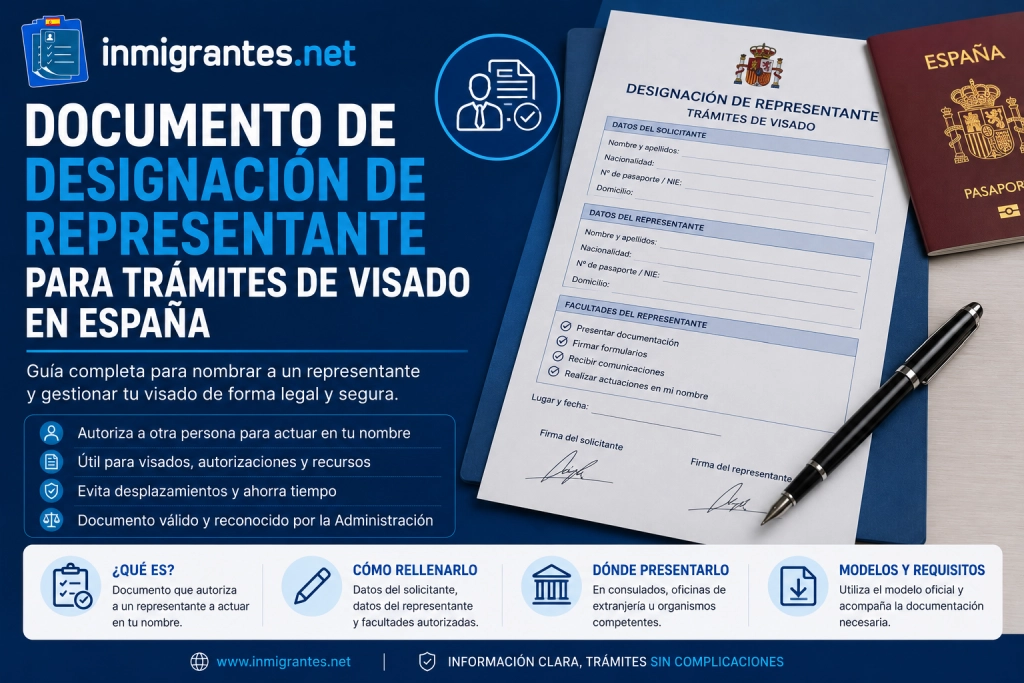
This document allows someone to act on behalf of the applicant in certain visa or immigration procedures. It must be completed carefully, signed correctly and accompanied by any documents required by the relevant consulate or office.
Document
Appointment of a representative
Common use
Visas and immigration
Signatures
Applicant and representative
Key point
Prove identity and authorisation
Quick summary
- The representative appointment document authorises another person to act on the applicant's behalf in certain procedures.
- It may be used in visa, residence, authorisation or immigration application procedures, where permitted by the relevant procedure.
- It must clearly state the details of the applicant and representative, as well as the procedure for which representation is authorised.
- It normally must be signed by the applicant and, in many cases, accompanied by a copy of the representative’s identity document.
- Errors in names, passport details, NIE, signatures or the scope of the authorization may lead to delays or requests for additional information.
The document appointing a representative for visa procedures is a written authorization by which a person allows another person to act on their behalf before a consular office, government authority or body responsible for immigration matters.
This document can be very useful when the applicant cannot handle certain matters in person, when a company, family member, lawyer or immigration adviser is involved, or when the procedure allows a third party to submit documents, receive communications or act on the applicant’s behalf.
Key point
There is no single rule that applies to all visas. Each consulate, visa type and procedure may require a specific form, a particular method of signing, a copy of the representative’s identity document or proof of their authority to act.
What is a document appointing a representative?
A document appointing a representative is one through which an applicant names another person to act on their behalf in a specific procedure. In visa and immigration matters, this representation may be used to submit documents, provide missing or corrected documents in response to a request, receive notifications or take part in certain stages of the application, provided the procedure allows it.
It should not be confused with a simple informal authorization. In many cases, it must include full details, signatures, information identifying the procedure and copies of documents proving the identity of both parties.
It is also important to understand that appointing a representative does not mean losing control of the application. The applicant remains the main interested party and may revoke or change the representation if the procedure allows it.
What is it used for in visa procedures?
In visa procedures, this document may allow another person to act on the applicant’s behalf when the consulate or government authority permits it. It may be useful for national visas, residence visas, student visas, work visas, applications linked to prior authorizations, or procedures involving a company or legal representative.
Submitting documents
The representative may submit forms, appendices, copies, supporting documents or additional documentation if the procedure allows it.
Responding to requests
They can help respond to requests to provide missing or corrected documents, or submit outstanding documents within the stated deadline.
Managing communications
In some procedures, they may receive notices or act as an authorized contact person.
Acting on the applicant’s behalf
Representation allows the representative to take part in the procedure within the limits set out in the document.
If you are preparing for a specific visa, also check the general documentation required for the procedure. For example, in some cases you may need official certificates such as a Spanish criminal record certificate, a birth certificate or legalized and translated documents.
When might you need one?
It is not always mandatory. It is mainly used when the applicant does not handle every matter in person or when the procedure requires the person acting on their behalf to be identified.
- When a company handles part of a foreign worker’s application.
- When a lawyer, immigration adviser or consultant submits documents on the applicant’s behalf.
- When a family member helps the applicant manage the visa process.
- When the applicant is a minor and their legal representative acts on their behalf.
- When the consulate requires proof of representation before accepting documents from a third party.
- When the procedure was started with prior authorization in Spain and documentation needs to be coordinated with the consulate.
Practical tip: Before signing or submitting the document, check the instructions of the specific consulate where the visa application will be processed. Requirements may vary between countries, consulates and visa types.
What information should it include?
The contents may vary depending on the form used, but it should normally include enough information to identify the applicant, the representative and the procedure for which the authorisation is granted.
| Information | Why it matters | Recommended checks |
|---|---|---|
| Applicant’s details | These details identify the person applying for the visa or associated with the application file. | First name, surname, passport number, NIE if applicable, nationality and address. |
| Representative’s details | These details establish who will act on the applicant’s behalf. | Name, identity document, telephone number, email address and address. |
| Authorised procedure | Specifies the matter for which representation is authorised. | Visa type, application file, consulate or organisation. |
| Representative’s powers | Specifies what the representative may do: submit documents, sign forms, receive communications or provide missing or corrected documents. | Avoid vague wording if the consulate requires specific details. |
| Signature and date | Give the document formal validity and establish when it was signed. | Check that the applicant has signed and, if applicable, that the representative has signed too. |
How to complete the document step by step
- Download the appropriate form from the source specified by the relevant consulate, office or administration.
- Enter the applicant’s details exactly as they appear in their passport or identity document.
- Enter the representative’s details without abbreviations and make sure the document number is correct.
- Specify the procedure for which representation is authorised: student visa, work visa, residence, prior authorisation or another procedure.
- Define the representative’s powers if the form allows it: submitting documents, signing forms, receiving communications or responding to requests for additional documents.
- Add the place and date of signature.
- Sign the document clearly and in accordance with the consulate’s instructions.
- Attach copies of the applicant’s and representative’s identity documents if required for the procedure.
- Check everything before submitting it, especially names, passport numbers, dates and signatures.
Common mistake
Do not use a template found online without checking that it is suitable for the consulate, country and type of visa you are applying for. An incorrect template may mean that the representation is not accepted.
Documents that may accompany the appointment of a representative
In addition to the appointment document itself, you may be asked to provide other supporting documents. The authority handling the application will usually want to verify the identities of both the applicant and the representative.
- Copy of the applicant’s passport.
- Copy of the representative’s identity document.
- Document proving the relationship or authority to act as a representative, where applicable.
- Copy of the visa application form.
- Application reference number or prior authorization, if any.
- Notarial power of attorney or specific authorization, if required by the consulate.
- Additional documents for minors, such as proof of parental responsibility or legal representation.
If the procedure is related to studies, you may also want to read our guide to health insurance for a student visa in Spain, as healthcare documentation is often an important part of the application.
Difference between a legal representative, an authorized representative and an immigration adviser
These roles are not all the same. It is worth distinguishing between them because each may have a different scope within the procedure.
Legal representative
Acts under a legally recognized relationship, for example, on behalf of minors or people who are legally represented.
Appointed representative
A person expressly authorized by the applicant to act on their behalf in a specific procedure.
Immigration adviser or agent
May help with the application, but must provide proof of authorization to act officially before the administration.
Authorized family member
May assist, but the family relationship alone is not always enough without formal authorization.
Can a representative sign the visa application?
It depends on the type of visa and the consulate’s instructions. Some appointment forms authorize the representative to submit and sign certain documents, but this does not mean that the representative can fully replace the applicant’s presence or signature in every procedure.
Some procedures require the applicant to appear in person, provide biometric data, attend an interview, sign documents or submit them directly. It is therefore essential to check the official guidance for the specific visa before assuming that the representative can do everything.
Important
Representation does not automatically remove the applicant’s personal obligations. If the consulate requires the applicant to be physically present, attend an interview or identify themselves in person, the applicant must do so even if they have a representative.
Common mistakes when preparing the appointment
Using the wrong template
Not all consulates accept the same format or wording.
Missing signature
A document without a signature or with an incomplete signature may not be valid.
Mismatched information
The name or passport details must match those on the other documents in the application file.
Failure to prove identity
You may need to provide a copy of the representative’s identity document.
Sample authorisation template
The following text is for guidance only. Before using it, check whether the consulate or relevant authority requires a specific official template.
Sample wording
Mr/Ms [APPLICANT’S FULL NAME], holder of passport/NIE/DNI number [NUMBER], appoints Mr/Ms [REPRESENTATIVE’S FULL NAME], holder of identity document number [NUMBER], as their representative to act on their behalf in connection with [TYPE OF VISA OR APPLICATION], with authority to submit documents, receive communications and take the necessary actions in that procedure, in accordance with the instructions of the competent authority.
At [PLACE], on [DATE]. Signature of the applicant and, if applicable, signature of the representative.
Frequently asked questions about the representative appointment document
What is a representative appointment document?
It is an authorisation by which an applicant appoints another person to act on their behalf in a specific procedure, such as a visa application or an immigration case.
Is it mandatory when applying for a visa?
Not always. It is only required when the procedure is handled through a representative or when the consulate or competent authority expressly requires it.
Who can act as a representative?
A representative may be a person authorised by the applicant, a family member, lawyer, immigration adviser, company or legal representative, provided that representation is permitted in the procedure and is properly documented.
Does the applicant have to sign it?
Yes. The document is normally signed by the applicant. In some cases, the representative’s signature or additional documents may also be required.
Will any template downloaded from the internet do?
It is not advisable to use just any template without checking it. It is best to use the official template or the format accepted by the consulate or office where the procedure will be submitted.
Can the representative receive notifications?
They can if the appointment authorises it and the procedure allows it. If this authority is needed, it is advisable to state it clearly in the document.
Conclusion
A representative appointment document can make many visa and immigration procedures easier, but it must be prepared correctly. The most important points are to use the appropriate template, correctly identify the applicant and representative, clearly define the authorised procedure, and provide the relevant identity document copies.
Before submitting it, always check the instructions from the consulate or competent authority to avoid delays, requests for additional documents or refusals due to formal errors.
This content is for informational purposes only and does not replace professional legal advice or information provided by the competent authorities.