

Guides by topic

Documents and Procedures

Find practical guides to documents and Spanish immigration procedures. Browse forms, certificates, fees, applications, legalisations and other common documents before starting a process. We have brought together resources to help you find the right procedure, check which documents may be required and access related resources…

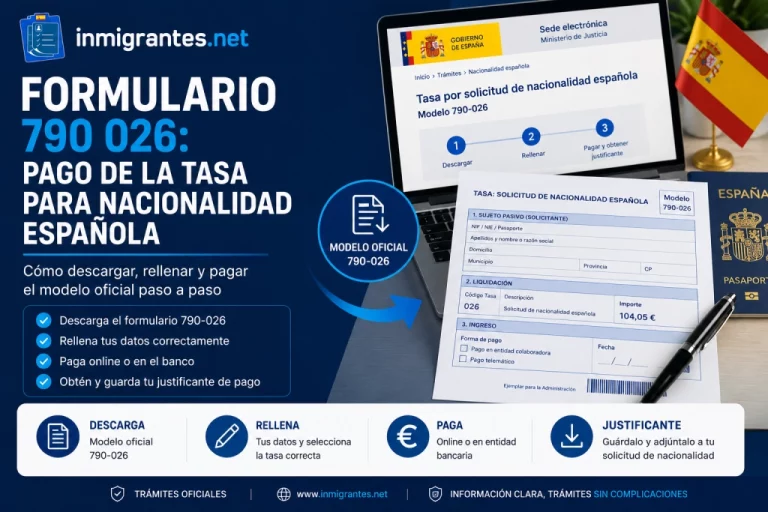
Form 790 026: how to complete, download and pay the Spanish citizenship fee

Form 790 026: download, complete and pay

Practical guide

Form 790 026: how to download and complete it and pay the Spanish citizenship application fee

Form 790, Code 026, is the official form used to pay the fee for an application for Spanish citizenship by residence. If you complete it incorrectly or save the wrong receipt, you may have problems when submitting your application.

Form

790 Code 026

Purpose

Citizenship by residence

Current amount

104,05 €

Proof of payment

Must be attached to the application file

Quick summary

  • The Form 790 026 is used to pay the fee for Spanish citizenship by residence.
  • It must be downloaded from an official source and completed with the applicant’s details.
  • For citizenship by residence, select the option in the form that corresponds to this application.
  • The fee must be paid before submitting the citizenship application.
  • The proof of payment must be kept and attached to the application file.

Form 790 026 is the official form used to pay the administrative fee required when applying for Spanish citizenship by residence. This form is not the citizenship application itself; it is the document used to pay the fee and obtain proof of payment.

It is a straightforward but very important step. If the form contains incorrect details, the wrong purpose is selected, or the correct proof of payment is not kept, the citizenship application file may be incomplete or lead to requests for additional documents.

Important distinction

This guide explains how to complete and use the form. If you need more general information about the cost, payment methods and when to pay, see the full guide to the Spanish citizenship fee 790 026.

What is Form 790 026

Form 790 Code 026 is the self-assessment form for the fee payable for an application for Spanish citizenship by residence. It records the applicant’s details, the fee category, the amount and the payment receipt number.

This form serves as proof that you have paid the fee required by the Ministry of Justice to process your application. Once you have paid it, keep the receipt and submit it with the rest of your application documents.

It should not be confused with other Form 790 versions. For example, the Form 790, Code 052 fee is used for certain immigration procedures, but not to pay the fee for Spanish citizenship.

Form 790 026: download, complete and pay
Image showing Form 790 026: download, complete and pay

Where to download Form 790 026

We recommend always downloading the form from the Ministry of Justice’s Government Online Portal or from the official Spanish citizenship application procedure. This helps you avoid using outdated forms, altered versions or intermediary websites that could cause confusion.

Recommended official link

You can visit the Ministry of Justice’s Government Online Portal to find the Spanish citizenship application procedure and Form 790 026: Ministry of Justice Government Online Portal.

Avoid downloading the form from unofficial websites unless you are sure it is the latest version. Even if the form looks the same, the instructions, fees or receipt generation system may have changed.

How to complete Form 790 026 step by step

Complete the form carefully. The details must match the applicant’s documents and Spanish citizenship application.

Section What to enter Recommended checks
Document NIE, DNI, passport or other applicable document. It must match the documents in your application.
First and last name The applicant’s full name. Follow the order and spelling shown on your documents.
Address The applicant’s full address. Include the municipality, province, country and postcode.
Date of birth Exact date of birth. Check that it matches the birth certificate.
Email address Contact email address. Use an active email address and check that it is entered correctly.
Fee category Application for Spanish citizenship by residence. Do not select fee categories that do not apply to your procedure.
Amount The amount in force at the time of payment. It is currently listed as 104,05 €, but you should check it before paying.

Which box to tick on Form 790 026

For an application for Spanish citizenship by residence, tick the item corresponding to Spanish citizenship by residence. Make sure you do not confuse it with other items that may appear on the form.

If you select the wrong option, the payment may not be correctly linked to the procedure you want to complete. Before confirming the payment, check that the selected item corresponds exactly to the application for citizenship by residence.

Important

Form 790 026 may include more than one option related to citizenship. For citizenship by residence, select the specific option for that procedure, not a different category.

Paying Form 790 026 online

Paying online is the most convenient option if you have access to the accepted electronic payment methods. You can make the payment and download the receipt without visiting a bank.

  1. Access the official procedure through the Government online portal.
  2. Find Form 790, Code 026.
  3. Enter the applicant’s details.
  4. Select the item for Spanish citizenship by residence.
  5. Check the amount before paying.
  6. Make the payment using an accepted method.
  7. Download the receipt issued.
  8. Save a digital copy and a backup copy.

When you pay online, the most important thing is to download the complete receipt and make sure it clearly shows the receipt number, the applicant’s details, the item and the amount paid.

Paying in person at a bank

If you prefer to pay in person, print Form 790 026 and go to a collaborating financial institution. You will make the payment there and receive the validated copy.

Validation may appear as a stamp, mechanical validation or an authorised signature from the institution. The important thing is to keep the copy that proves payment so you can submit it to the authorities.

Practical tip: If you pay at a bank, scan the receipt in good quality before uploading it to your application file. Make sure the applicant’s details, amount, bank validation and receipt number are clearly visible.

Which copy of Form 790 026 should you keep?

The form may produce several copies: one for the authorities, one for the applicant and one for the bank, depending on the payment method. They do not all serve the same purpose.

Copy for the authorities

This is usually the copy that proves payment in the application file. It must be validated if you pay at a bank.

Copy for the applicant

Keep it for your personal records. It may be useful if you need to check the payment later.

Copy for the bank

The bank usually keeps it when payment is made in person.

What is the receipt number on Form 790 026?

The receipt number is an important piece of information on the form. It identifies the payment made and links it to the relevant procedure.

When you submit your Spanish citizenship application, the system or your application file may require this receipt to verify that the fee has been paid correctly. For this reason, do not alter or crop it, or upload a document where it is not visible.

Common mistake

Uploading an incomplete screenshot, a blurry photo or a PDF where the receipt number is not visible may cause problems. Always upload the complete, legible receipt.

Who should be listed as the applicant on the form?

The payment must be made in the name of the person applying for Spanish citizenship. Even if a representative, lawyer, gestor, or family member handles the procedure, the form must contain the applicant’s details.

This is especially important for applications for minors, people who are legally represented, or applications submitted by a voluntary representative. The form may include details of the person submitting it or making the declaration, but the person liable for the fee must be the applicant when the procedure so requires.

Common mistakes when completing Form 790 026

Incorrectly spelled name

It must match the details in the other documents in the application file.

Incorrect NIE or identity document

An incorrect number may make it difficult to identify the payment.

Incorrect fee category

Do not confuse Spanish citizenship by residence with other fee categories.

Outdated amount

Always check the current amount before paying.

Incomplete receipt

The payment, validation and receipt number must all be visible.

Paying in someone else’s name

The payment must be linked to the citizenship applicant.

Checklist before paying Form 790 026

  • You downloaded the form from the Government online portal or another official source.
  • The form corresponds to Code 026.
  • You selected the option for Spanish citizenship by residence.
  • Your first and last names are written exactly as they appear on your documents.
  • Your NIE, DNI or passport details are correct.
  • The amount matches the current fee.
  • The payment is in the applicant’s name.
  • You have saved the complete receipt.
  • The PDF or scan is legible and has not been cropped.

After paying, the next step is to add the payment receipt to your citizenship application file along with the rest of the documents. You can also read the guide to the documents required to apply for Spanish citizenship.

Frequently asked questions about Form 790 026

What is Form 790 026?

This is the official form used to pay the fee for an application for Spanish citizenship by residence. Keep the proof of payment and attach it to your application file.

Where can I download Form 790 026?

Download it from the Ministry of Justice’s Government online portal or from the official Spanish citizenship application procedure. Avoid using outdated forms or unofficial sources.

Which option should I select on the form?

For an application for Spanish citizenship by residence, select the item for Spanish citizenship by residence on Form 790, Code 026.

How much is the fee for Form 790 026?

The current amount indicated by the Ministry of Justice is 104,05 €. However, it may be updated, so be sure to check the amount before paying.

Can someone else pay on my behalf?

Someone else may physically make the payment, but the form and payment must be in the name of the person applying for Spanish citizenship.

Which proof of payment should I upload to my application file?

Upload the complete proof of payment. If you pay at a bank, the copy must be validated. If you pay online, download the PDF generated by the system.

What happens if I make a mistake when filling in the form?

It depends on the mistake. Errors in essential details such as your name, identity document, payment item or proof of payment may cause problems when you submit your application. If in doubt, check the official instructions before paying.

Conclusion

Form 790 026 is an essential part of an application for Spanish citizenship by residence. It is not complicated, but it must be completed correctly, paid under the right item, and kept with complete, legible proof of payment.

Before submitting your application, check that the payment is in the applicant’s name, that the amount is correct, and that you can attach the proof of payment without any problems.
Tracking applications at the Central Civil Registry

Tracking applications at the Central Civil Registry

Quick summary: if you want to check the status of an application at the Central Civil Registry, a general explanation is not enough. There are several official tools, and they do not all serve the same purpose: a dedicated RCC status check, another for a Civil Registry application, another for viewing all your applications with Cl@ve, as well as separate services for requesting birth, marriage or death certificates.

The key to saving time is to first know exactly what you want to check: an RCC application, a certificate, a simple information query or the overall status of your Civil Registry applications.

Key points

The Central Civil Registry is not the same as “any Civil Registry procedure”. If you choose the wrong way to check, you may not find the application even if it exists.

Common mistake

Confusing a status check with a certificate request is a common mistake. They are different procedures, each with its own access point.

Good news

Civil Registry procedures and certificates are free of charge. If a website charges you to “process” a certificate, the Ministry is not the one charging you.

[toc]

What the Central Civil Registry is and what it usually handles

Understanding this will help you distinguish the RCC from other offices and services provided by the Ministry of Justice.

The Central Civil Registry is a registry under the Ministry of Justice. It records events for which no other Registry has jurisdiction, as well as those that, in exceptional circumstances, cannot be recorded at the Registry that would normally be responsible. It also maintains books containing duplicates of consular registrations and records other specific matters relating to civil status.

Birth

Births connected with another country

Among other cases, the RCC records births of Spanish nationals that take place abroad and births of foreign nationals who acquire Spanish nationality.

Marriage

Marriages celebrated outside Spain

It also handles registrations such as marriages celebrated abroad between Spanish citizens or between people who later acquire Spanish nationality.

Death

Deaths and other matters

This includes, for example, deaths of Spanish citizens that occur abroad and certain changes to the nationality or civil status of people born outside Spain.

How to track your application step by step

There is no single tool. Here are the most useful official options and when to use each one.

Official service Identification When to use it What you will usually need
Central Civil Registry application tracking Without a digital certificate When you know the matter is being handled by the RCC and want to check an application, duplicate, transfer or certificate from the Central Civil Registry. Number, year, matter type, first name, first surname and captcha.
Check the status of a Civil Registry application Without Cl@ve When you want to check a specific Civil Registry application and you are the applicant or the person registered. Application reference number shown on the receipt.
Check the status of my Civil Registry applications With Cl@ve When you want to see a complete list of Civil Registry applications in which you appear as the applicant or the person registered. Electronic identification using Cl@ve.
How is my application progressing? With Cl@ve For general enquiries about applications in progress with the Ministry of Justice. It is useful, but does not replace the specific Civil Registry access options when a procedure has its own portal. Electronic identification using Cl@ve.

Practical tip: if the procedure clearly falls under the Central Civil Registry, first try the RCC-specific enquiry service. If it does not appear or you are unsure which matter type to select, then check the general Civil Registry application status service or the “my applications” option using Cl@ve.

Information you will usually need to check with the RCC

Before accessing the online portal, have the details ready exactly as they appear on your receipt or in the procedure documents.

1

Application number and year

The RCC-specific enquiry service asks for the number and year. It is best to copy them exactly as they appear on the receipt.

2

Matter type

The form distinguishes between Case file, Duplicate, Transfer and Certificate. Selecting the wrong option may prevent the result from appearing.

3

First name and surname

The RCC requires these details to match those in the case file. Differences in accents, order or surnames used may cause the search to fail.

4

Acknowledgement or receipt

Keep it safe. For general enquiries about a Civil Registry case file, the Ministry itself says that the number can be found on the receipt issued when the application was submitted.

Civil Registry certificates: which service to use

If you need to request a certificate rather than track a case file, this is the important part.

With Cl@ve

Identified application

For birth, marriage or death certificates, the online portal allows you to apply electronically using electronic identification. If the information is available, the system can issue the certificate immediately in many cases.

Without Cl@ve

Application without identification

There are also procedures that do not require Cl@ve. In that case, the certificate is usually sent by ordinary mail to the address provided in the application.

CSV

Document verification

If you already have an electronic document issued by the Civil Registry, a dedicated service lets you verify and download it by entering its Secure Verification Code.

Important

Data enquiry is not a certificate

The “enquiry about Civil Registry registration data” is for information purposes only. It is not equivalent to a certificate and does not include certain marginal entries, such as divorce, nationality or changes of name and surname.

Timeframes

Not everything is issued immediately

The availability of an online procedure does not mean that all certificates are issued instantly. This depends on whether the information is available electronically and on the type of application.

Free

Certificates are free of charge

Civil Registry services and certificates are free of charge. If a private website offers to handle the procedure for a fee, that payment is not a fee charged by the Ministry of Justice.

What to do if your case file does not appear or is still pending

Before assuming that the case file has been lost, it is worth checking these basic points.

1

Make sure you are using the correct service

RCC case tracking is different from checking a general Civil Registry case file or requesting a certificate.

2

Check that the details match exactly

An error in the number, year, case type or surname may mean that no results are returned.

3

Distinguish between an application and a certificate

If you are looking for a birth, marriage or death certificate, you often need to use the specific certificate service rather than the “application tracking” service.

4

Use “my applications” if you have Cl@ve

This is the easiest way to see at a glance all Civil Registry applications in which you are listed as the applicant or the person registered.

5

Consider applying in person or through an authorised third party

The Ministry provides for using the government online portal, in-person assistance at Civil Registry offices and in-person assistance through collaborating service providers, such as notaries acting as intermediaries.

6

If your case is complex, seek professional advice

If there are identification errors, registrations abroad, inconsistent documents or long delays, it is advisable to review your approach before submitting anything again.

Not sure whether to use the RCC, certificates or “my applications” service?

This is the most common mistake. To avoid unnecessary trips and find out which service is actually right for your case, first review your approach before submitting repeat applications or wasting time on the wrong portals.

Official links worth saving

Keeping these links handy helps you avoid ending up on third-party websites or using the wrong forms.

Frequently asked questions about tracking applications at the Central Civil Registry

Clear answers to the questions most often asked about this procedure.

What information do I usually need to check an application with the RCC?

The Central Civil Registry’s specific enquiry service usually asks for the number, year, case type, first name, first surname and captcha.

Can I check the status of a Civil Registry application without Cl@ve?

Yes. The government online portal offers a service to check the status of a Civil Registry application without electronic identification, provided you are the applicant or the person registered and have the application number shown on your receipt.

What if I have Cl@ve?

You can then use the service to check the status of my Civil Registry applications, which lets you see a complete list of applications in which you are listed as the applicant or the person registered.

Does checking registry information count as a certificate?

No. Checking information about Civil Registry registrations is for information purposes only. If you need a document that serves as official proof, you must request the relevant certificate.

Do Civil Registry certificates cost anything?

No. Civil Registry certificates are free of charge. You should therefore always use the official portal or the relevant offices, and be wary of private websites that make it seem as though an official fee applies.

Can I request a certificate for someone else?

It depends on the case. The Ministry allows access by the person registered, their legal representative or authorised third parties. In some cases, you may need to demonstrate a legitimate interest or provide authorisation.

Can I use this service to track an application for Spanish citizenship by residence?

Don't assume that. Spanish citizenship by residence has its own dedicated online status-checking service, separate from the Central Civil Registry's tracking system.

NIE/TIE fingerprinting appointment (requirements and step-by-step process)

NIE/TIE fingerprinting

Fingerprinting is an in-person procedure at a police station that formalizes the issuance of the Foreigner Identity Card (TIE) once your residence authorization has been granted. The TIE will not be issued without this step, even if your application has been approved. The procedure is carried out by the National Police and requires an appointment.

What is fingerprinting and what is it for?

When the Immigration Office grants a residence authorization, the process does not end there. To obtain the physical card (the TIE), the foreign national must visit a National Police station to have their biometric data recorded: fingerprints from all 10 fingers and a digital photograph.

The TIE is the document that officially certifies your legal residence in Spain. It contains your first name, surname, nationality, date of birth, NIE, photograph and details of the permit granted.

NIE
Foreigner Identification Number

It is only an administratively assigned number. It is not a physical document in its own right. It appears on the decision and on the TIE.

TIE
Foreigner Identity Card

It is the physical card containing the NIE and biometric data. You receive it after fingerprinting. It is the document you must carry with you as a resident.

ℹ️

You can work with the decision. Once you have been notified that your application has been approved, you can work even if you do not yet have your physical TIE card. The positive decision serves as proof of your legal status while the card is being issued.

Documents to bring to your appointment

Always bring the original and a copy of each document. If any document is missing, the police station may refuse to process your application, and you will have to book another appointment.

For all cases (first issue)

✓
Complete original passport + photocopies of all pages

Copy of the personal details page and the pages with visas. Venezuelan citizens may use an expired passport under the instruction issued in January 2025.

✓
Positive decision granting the residence authorization

Original or official PDF downloaded from the government online portal. In most provinces, the online decision is sufficient—you do not need to wait for the paper letter.

✓
Completed and signed Form EX-17 (original + copy)

Download it from inclusion.gob.es. Fill it in carefully: errors in the NIE, name or type of authorization are the most common reason for refusal.

✓
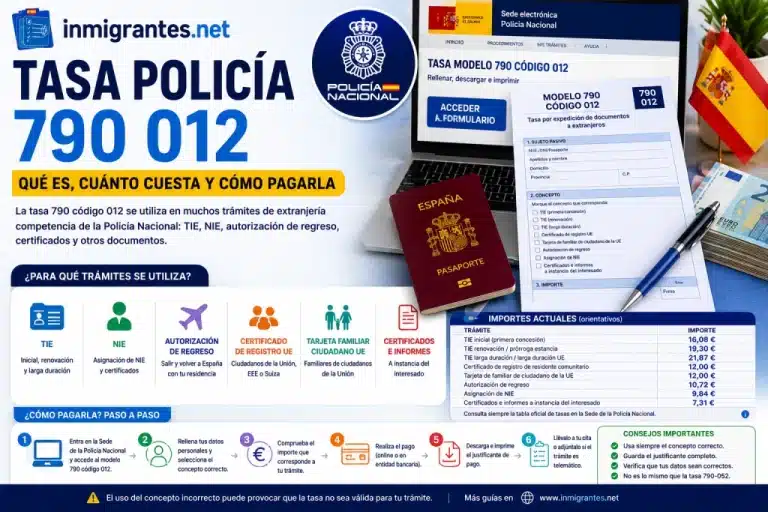
Proof of payment of the fee 790 – Code 012

Printed, even if you paid online. Always bring the printed proof of payment, even if the payment was made online. See the amounts in the next section.

✓
1 recent passport-size photograph

In colour, with a white background, facing forward, without glasses or a hat, and taken less than 2 years ago. Official dimensions: 32 x 26 mm. Although some police stations take your photo at the appointment, always bring one with you.

Additional documents depending on your situation

Situation Additional documents
TIE renewal Previous TIE (original) + updated municipal registration certificate (issued less than 3 months ago)
Replacement for a lost or stolen card Police report + replacement fee (different from the first-issue fee)
Minor The minor must attend with a parent or legal guardian, who must bring identification. Family record book or birth certificate.
Family reunification The family member joining the sponsor must be accompanied by the sponsor, who must bring their valid original TIE.
Work permit for employed work Registration with Social Security (reported to the Immigration Office at least 1 week before the appointment). Your application may be refused if this requirement is not met.

Fee 790-012: amounts for 2025 and how to pay

The fee for issuing the TIE is paid using Form 790, Code 012. The amount varies depending on the type of authorization and is reviewed annually. These are the fees in force in 2025:

First temporary residence
16,08 €
Renewal
19,30 €
Long-term residence
21,87 €
Family member of an EU citizen
12,00 €
⚠️

Check the fee when you generate the payment form. Fees are updated annually. Always use the official fee generator at sede.administracion.gob.es to make sure you pay the correct amount.

How can you pay it? You have three options:

1
Online (recommended)

At inclusion.gob.es/modelos-y-formularios. Generate the form, pay by card or direct debit, and download the receipt as a PDF. Print the receipt and bring it to your appointment.

2
At an ATM

Download and print the form, go to an ATM at any participating bank, and make the payment. You do not need to be a customer of the bank.

3
At a bank branch

Take the printed form to any participating bank. The bank will stamp the form as proof of payment. Keep all three copies.

How to book an appointment for fingerprinting

Book your appointment through the National Police portal, not through the Ministry of Inclusion’s online portal (which is for other immigration procedures). Fingerprinting is always handled by the National Police.

1
Go to the National Police appointment portal

Go to icp.administracionelectronica.gob.es and select your province.

2
Select the correct procedure

Choose “Issuance of Foreigner Identity Card” or “Fingerprinting (card issuance)”. Choosing the wrong procedure is a common mistake that invalidates the appointment.

3
Enter your details and choose a date

Enter your name, NIE or passport number, and email address. You will receive confirmation by email. Save the confirmation — you will need it on the day of your appointment.

⚠️

Book your appointment as soon as possible after receiving the decision. Although there is no fixed legal deadline, waits of several weeks are possible in cities such as Madrid and Barcelona. The sooner you book, the better. Check the portal early in the morning, when new appointments become available.

Step-by-step process on the day of your appointment

1
Arrive 10-15 minutes early

Show your appointment confirmation at the entrance. Some police stations have a preliminary access check.

2
Submit your documents at the service counter

The officer will check that all your documents are in order before starting the biometric process.

3
Fingerprinting and digital photograph

This is done using a digital scanner to capture all 10 fingerprints and a photograph. The entire process at the counter usually takes between 15 and 30 minutes.

4
You will receive a receipt — keep it safe

The receipt confirms that you have completed the procedure and is required to collect your TIE. It is valid as a provisional document if you need to show that your procedure is in progress. Do not lose it.

When and how to collect your TIE

Once your fingerprints have been taken, the card is produced within 20 to 40 working days. The timeframe varies depending on the police station and the volume of applications.

📅
Production time

Between 20 and 40 working days. Some police stations notify you by SMS or email. If you do not receive a notification, go in after 3-4 weeks with your receipt.

🪪
What to bring when collecting your card

Fingerprinting receipt + original passport. Most police stations no longer require an appointment to collect your card — check with yours.

✈️
Can I travel while I wait?

Yes, with your receipt + passport + decision. To leave Spain, you need to apply for a Return Authorisation if your visa has expired.

Common mistakes to avoid

✗
Booking an appointment before receiving a positive decision

Without an approved decision, the police station cannot process your TIE, and you will lose your appointment.

✗
EX-17 completed incorrectly or with the wrong NIE

Check the NIE number on your decision before completing the form. This is the most common mistake.

✗
Not bringing a printed fee payment receipt

Even if you paid online, the police station requires a paper copy of the receipt. Always bring a printout.

✗
Unsuitable photograph

A photo with a coloured background, glasses or a hat, or one taken more than 2 years ago. Always bring several recent copies.

✗
For employed work: failure to notify Social Security of your registration

If your permit is for employed work, you must be registered with Social Security and have notified the Immigration Office at least 1 week before your fingerprinting appointment. Without this step, your application may be rejected.

✗
Municipal registration for more than 3 months (for renewals)

For renewals and replacement cards, your municipal registration certificate must be less than 3 months old. Renew it before your appointment if necessary.

Do you have questions about your appointment or documents?

Our immigration lawyers can review your documents before your appointment to help you avoid any problems.

Consult a lawyer →

Frequently asked questions

+
Can I have my fingerprints taken without a paper copy of the decision?
In most provinces, yes. The decision downloaded from the government online portal or a screenshot showing the status “approved” in the system is enough to book the appointment and complete the procedure. You do not need to wait for the physical letter, which may take between 15 and 20 days to arrive at your home. Check with your local office in case there are any exceptions.
+
How long does it take for the TIE to be ready after fingerprinting?
The usual production time is 20 to 40 working days (approximately 4 to 8 weeks). This may vary depending on the police station and the number of applications. Some police stations send an SMS or email when the card is ready; if you do not receive a notification, go to the police station with your receipt after 4 weeks.
+
What happens after fingerprinting?
You will receive a receipt confirming that the procedure is underway. You can use this receipt, your passport and the decision to prove your legal status and work. After 3-4 weeks (or when notified), return to the same police station with the receipt and your passport to collect your physical TIE card.
+
I can’t get a fingerprinting appointment. What can I do?
This is common in high-demand cities such as Madrid and Barcelona. Try: (1) checking the portal early in the morning, when cancelled appointments become available; (2) trying police stations in nearby municipalities in the same province; (3) if your decision is about to expire, going to the police station in person to explain the urgency. Keep evidence of unsuccessful attempts in case the situation becomes more complicated.
+
Can I travel outside Spain while waiting for my TIE?
Yes, but take precautions. If your entry visa has already expired, you need to apply for a Return Authorization before leaving so that you can re-enter Spain. The fingerprinting receipt, passport and decision are valid documents within Spain, but some countries may require the physical card to grant you entry.
+
Do I have to go to the police station in my province, or can I go to any station?
Generally, you must go to the police station responsible for your place of municipal registration. However, some provinces allow you to go to any police station with availability. If you have trouble getting an appointment in your province, check whether nearby police stations in the same province will accept your case.
+
I’ve lost my fingerprinting receipt. What should I do?
Go to the same police station where your fingerprints were taken and explain the situation. They can locate your file using your passport and personal details. You do not need to have your fingerprints taken again, but you will not be able to collect your card without first clarifying the situation if you do not have the receipt.

States party to the Hague Convention

The Hague Convention, signed in 1961, has transformed the way public documents are recognised internationally. This agreement facilitates the movement of documents between countries, eliminating the need for multiple legalisations. As the list of Hague Convention signatory states grows, it is becoming an essential tool for the globalisation of legal procedures.

Below, we explore various aspects of the Hague Convention, including its importance, the countries that have ratified it and how it affects international procedures.

Which countries are the main signatories to the Hague Convention?

The list of Hague Convention signatory states includes a range of nations from different continents. Some of the most notable are:

  • United States
  • Germany
  • France
  • Japan
  • Brazil
  • Spain

These countries have recognised the importance of the Convention in improving the flow of documents. They all benefit from the authenticity and reliability provided by the apostille.

There are also other countries in the process of acceding to the Convention, demonstrating global interest in simplifying legal procedures. It is important to note that the list of countries that are party to the Hague Convention is updated periodically.

What is the 1961 Hague Convention and why is it important?

The Hague Convention is an international treaty that establishes rules for the legalisation of public documents. Its main aim is to simplify administrative procedures by eliminating the need for multiple legalisations. This is especially important in an increasingly globalised world, where individuals and businesses need to move documents easily from one country to another.

The Convention is important for several reasons:

1. Mutual recognition: Apostilled documents are accepted in signatory states without any need for additional verification.

2. Faster procedures: It reduces waiting times and the costs associated with legalising documents.

3. Legal certainty: It provides a clear and reliable framework for the movement of public documents.

Since it entered into force in 1965, this Convention has made life easier for millions of people around the world.

How does the Hague Convention facilitate the movement of documents?

The Hague Convention allows public documents issued in one member country to be recognised in other signatory states. This is done through an apostille system: a certificate that confirms the authenticity of the document.

Benefits of moving documents:

  • Simplifies education-related procedures: Apostilled academic qualifications are accepted abroad without complications.
  • Speeds up legal procedures: Contracts and court documents can be used in different jurisdictions without further legalisation.
  • Promotes international trade: Businesses can submit commercial documents more easily, encouraging trade between nations.

This system not only reduces the bureaucratic burden but also fosters an environment of international trust and cooperation.

What documents can be apostilled under the Hague Convention?

The Hague Convention allows a range of public documents to be apostilled, including:

Types of documents that can be apostilled:

  1. Birth certificates
  2. Marriage certificates
  3. Judicial documents
  4. Academic certificates
  5. Notarial documents

Apostilling these documents ensures they are recognised in other contracting states without the need for additional procedures. This is crucial for individuals and businesses looking to operate internationally.

What is the current list of contracting states to the Hague Convention?

The list of contracting states to the Hague Convention currently includes 127 countries, representing significant progress in international cooperation. Some of the countries added in recent years include:

  • Serbia
  • Uzbekistan
  • Malta

Every year, the Hague Conference on Private International Law reviews and updates this list, allowing more nations to join the agreement. This not only simplifies procedures but also strengthens the interoperability of the global legal system.

How does the Hague Convention affect international procedures?

The Hague Convention has a considerable impact on international procedures. By reducing the complexity of document legalisation, it opens the door to a range of opportunities.

Key aspects of its impact:

1. Facilitating international mobility: People wishing to work or study abroad can submit their documents easily.

2. Recognition of rights: The Convention ensures that the rights and obligations arising from public documents are recognised in other countries.

3. Lower costs: Eliminating multiple legalisations means significant savings on fees and bureaucracy-related expenses.

In short, this Convention is a key tool for promoting international cooperation and trust.

What are the advantages of apostilling documents under the Hague Convention?

There are many advantages to apostilling documents, for both individuals and organisations. Apostilling not only simplifies the process but also offers a range of additional benefits.

Some advantages of the Hague Convention for international procedures:

  • Simplified procedures: Makes it easier to submit documents without legal complications.
  • Improved access to services: Enables people to access public services abroad without obstacles.
  • Reduced waiting times: Cuts down the time that would otherwise be needed to legalise documents in different countries.

These advantages have helped make the Hague Convention a fundamental pillar of international document legalisation.

Related questions about the Hague Convention

Which countries are signatories to the Hague Convention?

The list of signatory states to the Hague Convention includes countries from every continent. It continues to grow, reflecting global interest in legal cooperation. Signatories include countries such as Germany, Brazil, Japan and many others that have recognised the importance of the apostille in facilitating the movement of documents.

Is Cuba a party to the Hague Convention?

No, Cuba is not a party to the Hague Convention. This can complicate matters for those who need to submit Cuban documents in countries that have ratified the Convention. This means Cuban documents may require more complex legalisation procedures.

What are the requirements for getting a document apostilled?

To get a document apostilled, you generally need to follow these steps:

1. Document verification: Make sure the document is a public document.
2. Apostille application: Submit the document to a competent authority in the country where it was issued.
3. Payment of fees: Depending on the country, there may be a fee for the apostille service.

It is important to check with the relevant organisation for specific details about the process.

How does the Hague Convention affect people taking documents abroad?

The Hague Convention benefits people by making it easier for their documents to be recognised in other countries. This means that people who wish to move, work or study abroad can do so with fewer complications and greater confidence that their documents will be accepted.

Where can I find the full text of the Hague Convention?

The full text of the Hague Convention is available on the website of the Hague Conference on Private International Law. The website also provides amendments and updates relating to the treaty, as well as further information about the signatory countries and their commitments.

Form 790 fee for a criminal record certificate: a complete guide

The criminal record certificate in Spain is an essential document for anyone who needs to prove their legal status to institutions or as part of administrative procedures. This article covers everything from obtaining the certificate to paying the relevant fee.

Criminal record certificate in Spain

The criminal record certificate is an official document confirming whether or not a person has convictions recorded in the Central Register of Convicted Persons. It is issued by the Ministry of Justice and is required in many situations, such as competitive examinations for public-sector positions or citizenship procedures.

To apply for this certificate, you must provide a DNI or passport and Form 790, the specific form used to pay the fee. There are several ways to apply, each with its advantages and disadvantages.

How do you apply for a criminal record certificate?

There are several ways to apply for a criminal record certificate. Here are some of the most common options:

  • Online, using a digital certificate.
  • In person, at Ministry of Justice offices.
  • By post, by sending the required documents.
  • Through a representative in Spain.

The online option is the quickest and most efficient, making the process simple and convenient. Applying online can also help you avoid long waits and unnecessary journeys.

What is the Form 790 criminal record fee?

Form 790 is used to pay the fee for applying for a criminal record certificate. This fee must be paid regardless of the application method chosen.

Form 790 is divided into several sections, which must be completed with personal details and the reason for the application. You must submit this form along with the other required documents.

Who can apply for a criminal record certificate?

In principle, anyone can apply for their own criminal record certificate. However, legal representatives can also apply on someone else's behalf, provided they have the necessary documents.

This certificate is particularly relevant for:

  • People taking part in competitive examinations for public-sector positions.
  • Foreign nationals applying for Spanish citizenship by residence.
  • People who need the certificate for work or educational procedures.

Please note that if you apply for someone else’s certificate, you will need their explicit consent and the relevant documentation.

What are the ways to apply for the certificate?

There are several ways to apply for a criminal record certificate, each suited to different needs and circumstances. The most common options are detailed below:

  1. Online application: Through the Ministry of Justice website, using a digital certificate.
  2. In-person application: At any Ministry of Justice office or Territorial Office.
  3. By post: Send the required documents to the Central Register of Convicted Persons.
  4. Through a representative: If you are abroad, you can appoint someone to manage the application in Spain.

Each method has its own advantages, although applying online is generally the most efficient option.

How can I pay the fee for a criminal record certificate?

The Form 790 fee can be paid in several ways. Here are the most common options:

One of the easiest ways is to pay online through the Ministry of Justice portal. However, if you prefer to pay in person, you can visit an authorised bank.

Also, remember that you must submit the duly completed Form 790 when making the payment. This document is essential because it contains the Secure Verification Code, which validates the transaction.

Finally, bear in mind that in some cases, for example if you are abroad, you may need to arrange payment differently, depending on your bank.

How much is the Form 790 fee for a criminal record certificate?

The Form 790 fee for a criminal record certificate may vary depending on how you apply. It is generally around 3,75 euros. However, we recommend checking the official Ministry of Justice website for up-to-date information on the amount.

Please note that although this is the usual fee, exceptions or discounts may apply depending on the applicant’s personal circumstances, for example if they are a pensioner or unemployed.

The fee must be paid when you submit the application, so it is important to take this into account when planning the procedure.

Related questions about criminal record certificates

How can I pay the Form 790 fee for a criminal record certificate?

Paying the Form 790 fee for a criminal record certificate is straightforward. You can pay online through the Ministry of Justice portal or in person at a bank. If you choose to pay online, make sure you have a digital certificate that allows you to access the system.

You must also submit the correctly completed Form 790, as it contains essential information for validating your payment. If you are outside Spain, check the options available for making payment from abroad.

How much does Form 790 for criminal records cost?

The fee for Form 790 for a criminal record certificate is generally 3,75 euros. This amount may vary, so we recommend checking the Ministry of Justice website for up-to-date information and to confirm the exact amount. In some cases, discounts are available to people in special circumstances, such as unemployed people or pensioners.

How do I download Form 790?

To download Form 790, visit the Ministry of Justice website. In the fees section, you will find the specific Form 790 for criminal record certificates. Simply select the download option, complete the form with your personal details and follow the payment instructions.

What is the amount of the Form 790 fee?

The Form 790 fee for a criminal record certificate is usually 3,75 euros. This amount may differ depending on the application method and whether any discount applies. We recommend checking the Ministry of Justice website regularly for possible changes to the fees.

A criminal record certificate is an essential document for various legal and administrative procedures. Understanding how to obtain the certificate and pay the Form 790 fee for criminal records is key to making the process easier.

Instructions for applying for a residence authorization

Applying for a residence authorization can seem complicated, but with the right instructions, it becomes more manageable. This article aims to guide you through the steps involved in managing applications for Spanish immigration authorizations, including the requirements and necessary documents.

The system allows a range of authorizations to be managed online, simplifying the process through the government online portal of the Ministry of Inclusion, Social Security and Migration. The essential steps and requirements for completing this process are outlined below.

Instructions for applying for an entrepreneur authorization

To apply for an entrepreneur authorization, you must follow a series of steps. First, register on the government online portal of the Ministry of Inclusion. Then complete the specific form for entrepreneurs, available on the portal.

You must attach documents supporting your project, such as a business plan, as well as information about your personal and professional background. Remember that you must have a digital certificate to sign the application electronically.

Once you have submitted your application, you will receive a tracking number that will allow you to check its status. It is advisable to do so regularly to make sure that no documents or additional information are missing.

Instructions for completing the application for health authorization and registration with ROESBA

A health authorization is an essential requirement in certain sectors, such as food or healthcare. To apply for one, you must submit a form containing all the information about the activity you plan to carry out.

You must also be registered with the Official Register of Biocidal Establishments of Andalusia (ROESBA). To do so, you will need to provide evidence that you comply with the applicable health regulations.

Carefully check the specific requirements that may apply to your activity, as they can vary depending on the type of business. The application must be submitted online through the Ministry’s government online portal, where you will also find the applicable regulations.

What is an authorization to return under Spanish immigration procedures?

An authorization to return is a document that allows foreign nationals with a residence permit to return to Spain after travelling abroad. This authorization is essential for those who need to leave the country temporarily and wish to maintain their residence status.

To apply for one, you must submit your application to an Immigration Office, together with documents confirming your situation. Keep in mind that processing times may vary, so it is advisable to apply in advance.

An authorization to return may also be required when renewing a residence permit. In this case, it is essential to submit the correct application and meet the deadlines set out in the applicable legislation.

What documents do I need to apply for a residence permit?

When applying for a residence permit in Spain, it is essential to have the right documents. You will generally need the following:

  • Valid passport or identity document.
  • Completed application form.
  • Proof of sufficient financial means.
  • Health insurance.
  • Criminal record certificate.

In addition, depending on the type of permit you are applying for, you may need to attach additional documents. For example, if you are applying for a work permit, you must include the employment contract and the employer’s authorization.

It is important to ensure that all your documents are in order and meet the requirements set out in Spanish regulations to avoid delays in processing.

How do you submit an application for a residence authorization?

Submitting an application for a residence authorization involves completing several essential steps. First, log in to the Ministry of Inclusion’s government online portal, where you will find the form for your situation.

Once you have the form, complete it carefully, making sure all the details are correct. Then attach all the required documents and proceed to pay the fees, which is also done online.

We recommend keeping a copy of all the documents you submit and the proof of payment. This will be useful for checking your application status and resolving any issues that may arise.

Official application forms for Spanish immigration authorizations

Application forms are standardised documents that make the administrative process easier. You can find the official forms to use for the type of authorization you need on the Ministry of Inclusion’s government online portal.

It is essential to use the correct form, as each one is designed for a different type of authorization, whether for residence, work or family reunification. Make sure you download the latest version and follow the specific instructions provided with each form.

Each form may also require different information, so carefully check which documents you need to attach to complete your application.

Related questions about managing Spanish immigration authorizations

How do you apply for an authorization?

To apply for an authorization, register on the Ministry’s government online portal and complete the relevant form. You will need a digital certificate and must submit all the required documents, such as your passport and proof of financial means.

How do you write a letter to apply for a permit?

When writing a letter to apply for a permit, make sure to include your personal details, the reason for your application and the documents you are attaching. The letter should be clear and concise and effectively explain the purpose of your application.

How do you apply for prior authorization?

To apply for prior authorization, use the government online portal to complete the appropriate form and submit documents supporting your application. It is essential to follow the specific instructions for each type of authorization.

What is the authorization process?

The authorization process varies depending on the type of permit you are applying for. In general, it involves submitting the application, having the documents reviewed, paying the fees and waiting for a decision. Keep an eye out for any requests for additional documents from the authorities.

Alternative system for booking an appointment at the Immigration Office in 2025

The process of using an alternative system to book an appointment at an Immigration Office is essential for anyone who needs to complete immigration procedures in Spain. With demand for appointments continuing to rise, it is crucial to understand how the system works and what steps to take to secure an appointment.

This article covers how the appointment system works, the documents you need, which procedures require an appointment, and more. It will help you manage your dealings with Immigration Offices more effectively.

What is the alternative system for booking an immigration appointment?

The alternative system for booking an appointment at an Immigration Office allows users to manage their appointments more efficiently, avoiding long queues and a lack of availability. It is designed to make immigration services more accessible and reduce waiting times.

Users can access this system through the Government online portal, where they can select the procedure they need and choose the most convenient date and time. This ensures an efficient and orderly process.

The system is also regularly updated to meet people’s needs and improve the user experience when managing procedures. Its implementation is a step towards modernising public administration.

How does the appointment system at the Immigration Office work?

Booking a immigration appointment in 2025 is straightforward. Follow these steps:

  • Go to the relevant Government online portal.
  • Select the procedure you need to complete.
  • Choose an available date and time for your appointment.
  • Confirm the appointment and receive the relevant notification.

It is important to note that an appointment is required for most procedures at Immigration Offices. These include applications for work authorizations, residence permit renewals and more.

The system also lets you change or cancel appointments, giving users greater flexibility. However, it is advisable to make these changes well in advance to avoid any problems.

What documents do I need for my immigration appointment?

The documents required may vary depending on the procedure. However, certain documents are commonly needed for most appointments. These include:

  1. DNI or passport, as applicable.
  2. The application form for the relevant procedure.
  3. Specific documents supporting the application, such as employment contracts or proof of residence.

It is essential to prepare all the required documents before attending your appointment at the Immigration Office. This not only speeds up the process but also helps prevent potential problems or refusals.

You should also check the requirements on the Government online portal, as regulations may change or additional requirements may apply depending on the type of application.

Which procedures require an appointment at the Immigration Office?

Several procedures require an appointment at an Immigration Office. Some of the most common are:

  • Applications for residence and work authorizations.
  • Residence permit renewals.
  • Family reunification procedures.
  • Asylum and international protection applications.

These procedures are essential for foreign nationals who wish to live or work in Spain. Appointments ensure that each application is handled promptly and in an orderly manner.

Some specific procedures may also require additional documents, so it is advisable to check the requirements before booking your appointment.

Where can I find Immigration Office opening hours and contact numbers?

To find information about Immigration Office opening hours and contact details, visit the official National Police website or the Government online portal. There you will find:

  • Public opening hours.
  • Telephone numbers for enquiries.
  • Addresses of the different offices.

For general enquiries and technical issues with the appointment system, we recommend calling 060. This service is available to help people manage their procedures.

You can also find specific information on other official platforms, such as the ICAB website, which provides details about the use of cookies and the handling of personal data.

What should I do if no appointments are available at the Immigration Office?

Sometimes all appointments at Immigration Offices may be fully booked. If this happens, you can try the following:

  • Check availability at different offices.
  • Find out whether an emergency appointment system is available for specific cases.
  • Try again later, as appointments may become available.

You should also keep an eye on updates to the Government online portal, where new appointment slots may be posted. Persistence is key to securing an appointment.

If you have an urgent situation, contact the relevant office to explain your case and ask about alternatives. Telephone support can be very helpful in these situations.

Tips for booking an Immigration Office appointment without any hassle

Here are some useful tips to make it easier to book an appointment:

  1. Prepare all the required documents before booking your appointment.
  2. Access the system at quieter times, such as early in the morning or late in the afternoon.
  3. Have your DNI or passport and the details of your procedure ready.

We also recommend using an up-to-date web browser to avoid technical problems during the application process. The online appointment booking for Spanish immigration procedures process is quick when completed correctly.

Finally, ask friends or family members who have been through the same process for advice. Their experience may offer valuable tips and tricks to help you manage it successfully.

Related questions about the immigration appointment system

What should I do if I can't get an immigration appointment?

If you can't get an appointment at an Immigration Office, the first thing you should do is check availability at different offices. Sometimes, appointments may be available in other towns when your local office has none. You can also try again at different times of the day or week.

Another option is to check the Government online portal regularly to see whether new appointments have become available. If your case is urgent, it is advisable to call the office, explain your situation and ask whether they offer any alternative solutions.

What is the best time to book an appointment at the Immigration Office?

The best time to arrange your immigration appointment is usually early in the morning or early in the afternoon. Demand is less likely to be high at these times, which may make it easier to access the system.

It is also recommended that you avoid weekends and public holidays, as many people try to book appointments then. Trying at less busy times may increase your chances of success.

How can I speed up my immigration procedure?

To speed up your immigration procedure, it is essential to have all the necessary documents ready before your appointment. It is also useful to familiarise yourself with the process and the steps you need to follow, so you don't waste time during your appointment at the office.

Another important tip is to make sure your information is up to date in the Government online portal, as this may prevent unnecessary delays. If you have any questions, don't hesitate to contact the telephone helpline for assistance.

What is the name of the Social Security app for booking an appointment?

The Social Security app for booking appointments is called “Cita Previa Seguridad Social”. It allows users to easily and quickly manage appointments for various Social Security procedures.

Using this app, users can choose the type of procedure they need to complete and select the office and time that suit them best, making it easier to manage Social Security appointments.

Legalization and MAEC information: everything you need to know

Document legalisation is an essential procedure for ensuring that documents are valid abroad. The Ministry of Foreign Affairs and Cooperation (MAEC) facilitates the legalisation of documents that need to be recognised internationally. In this article, we take an in-depth look at the different aspects of MAEC legalisation and information.

Understanding this process is crucial, especially if you plan to use documents abroad for work, academic or personal purposes. Below, we take a closer look at the legalisation services offered by the MAEC and explain how you can complete the procedure.

Legalisation service

The MAEC offers a comprehensive document legalisation service. This procedure allows official documents to be accepted in other countries by confirming their authenticity. Legalisation can be carried out in several ways, most commonly by submitting documents directly to MAEC offices or through embassies and consulates.

One of the most important things to know about the legalisation service is that it is free of charge. However, it is essential to follow the correct steps to avoid delays. Documents that often require legalisation include birth certificates, marriage certificates and academic documents, among others.

The MAEC also provides detailed information about the process and the requirements for legalising each type of document. It is therefore advisable to visit its website or contact its offices before starting the procedure.

What does diplomatic legalisation of documents involve?

Diplomatic legalisation is the process of verifying the authenticity of a document issued in one country so that it can be recognised in another. This procedure does not certify the document’s contents; it confirms that the signature and seal are genuine.

There are several types of legalisation, including fast-track procedures and those that take longer. Diplomatic legalisation is most commonly used for public and private documents that need to be submitted to foreign authorities.

This process is essential for ensuring the international mobility of people and documents, thereby facilitating trade, education and other aspects of social life. It is important to note that some documents may not require this procedure if they are covered by international agreements, such as the Hague Apostille.

How do you book an appointment to legalise documents at the MAEC?

To legalise documents at the MAEC, you need to book an appointment. This can easily be done through its website. Here are the steps to follow:

  1. Visit the MAEC website.
  2. Go to the section for booking appointments to legalise documents.
  3. Choose a date and time that suits you.
  4. Complete the form with your personal details.
  5. Confirm your appointment and make sure you bring the required documents on the day.

It is advisable to complete this procedure in advance, as demand can be high and waiting times vary. Make sure you have all the necessary documents ready to avoid complications.

What types of documents can be legalised?

The MAEC allows a wide range of documents to be legalised. These include, but are not limited to:

  • Birth certificates.
  • Marriage certificates.
  • Academic documents and university degrees.
  • Employment contracts.
  • Commercial documents.

It is essential to make sure that documents have been properly signed and stamped before starting the legalisation process. Some documents, such as those issued by the Ministry of Education or embassies, may require an additional process before they can be legalised.

What methods are available for legalising documents?

There are several ways to have documents legalised in Spain. The most common are:

  • Submitting them in person at the MAEC offices in Madrid.
  • Sending them by registered post.
  • Arranging the process through embassies or consulates.
  • Using authorised administrative agents.

Each method has its own advantages. For example, submitting documents in person may be faster, while sending them by post is convenient for those who cannot travel. It is essential to choose the method that best suits your needs and circumstances.

How long does diplomatic legalisation take?

The estimated time for the diplomatic legalisation of documents is approximately 15 working days. However, this may vary depending on the volume of applications and the time of year.

It is important to bear in mind that some methods, such as submitting documents in person, may speed up the process. If you need a document urgently, be sure to tell MAEC staff about your situation when you submit it.

What exemptions from diplomatic legalisation are there?

There are certain exceptions where document legalisation is not required. These include documents covered by the Hague Apostille and other international agreements. Generally, documents issued by countries that are party to these agreements do not require further legalisation.

It is essential to check with the MAEC or the relevant embassy to find out whether your document is exempt from this process. This not only saves time but may also reduce the costs associated with legalisation.

What is the process for apostilling documents in Spain?

The apostille of documents is a simplified procedure that validates documents for use in other countries. The process for apostilling documents in Spain is as follows:

  1. Gather all the documents you need to have apostilled.
  2. Go to the competent authority, which may be the MAEC or the relevant regional offices.
  3. Submit the documents and request the apostille.
  4. Collect the documents once they have been apostilled.

It is important to check in advance whether the document needs an apostille or must be legalised in another way. Apostilling is usually faster and less expensive, so it is the preferred method in many cases.

Related questions about the document legalisation and apostille process

What is document legalisation?

Document legalisation is the process of authenticating a document so that it can be recognised abroad. This involves validating the document’s signature and seal through the relevant legal procedure.

This procedure is essential to ensure that a document issued in one country is accepted in another, particularly documents relating to legal, educational or employment matters. It is important to note that legalisation does not guarantee the contents of the document, only the authenticity of its origin.

How are documents legalised in Spain?

In Spain, documents are legalised through the MAEC or via embassies and consulates. The process involves submitting the document along with the required forms and meeting certain requirements.

Legalisation can be completed in person or by post, depending on the applicant’s preferences and needs. It is advisable to check the specific requirements, which may vary depending on the type of document to be legalised.

Which documents do not need legalisation?

Some documents are exempt from legalisation, particularly those bearing an apostille under the Hague Convention. This includes documents issued in countries that are party to this international agreement.

In addition, certain documents issued by high-level public authorities may not require this procedure. It is essential to check with the MAEC whether your document is exempt, to avoid unnecessary procedures.

How much does document legalisation cost?

The document legalisation process at the MAEC is free of charge. However, if you choose to use the services of administrative agents, fees may apply. If you decide to use this service, it is advisable to research and compare prices.

How do you apply for an apostille in Spain?

In Spain, you apply for an apostille at the same place where documents are legalised. You must submit the document in question along with the apostille application and meet the applicable requirements.

The procedure is usually quick, and you may receive your apostilled document on the same day, depending on the office’s workload. Make sure you have all the required documents to avoid delays.

When to pay the immigration fee

Immigration fees are an important part of the administrative process for people seeking to live or work in Spain. In this article, we will explore when to pay the immigration fee and other relevant aspects of this topic.

Since the new 2025 regulations came into force, it has been essential to know the applicable fees and related procedures. Below, we will cover various aspects to help you better understand this process.

What are immigration fees?

Immigration fees are charges that must be paid for certain procedures relating to residence and work in Spain. These procedures may include permit renewals, residence applications and other administrative services. Each procedure has a specific fee, which may vary depending on the applicant’s circumstances.

These fees are intended to fund the immigration services system and ensure that procedures are handled properly. The National Police and the Ministry of Inclusion are the bodies responsible for administering these fees.

It is important to remember that not all immigration procedures incur fees, and some applicants may be exempt from paying them in certain circumstances.

When do you pay the immigration fee?

The key question is when to pay the immigration fee. These fees generally have to be paid when you submit the application for the relevant procedure. It is essential to make sure the payment is made before submitting the documents to avoid delays.

If the fee is not paid at the right time, the application may be refused. It is therefore advisable to check the deadlines and specific requirements for each procedure. For example, when applying for authorization to stay, you must submit proof of fee payment along with the required documents.

In addition, you may have to pay again if you file an appeal or if the original application does not progress properly through the administrative process.

How much does each immigration procedure cost?

The cost of the immigration fee in Spain varies depending on the type of procedure. In general, fees can range from a few euros to more than 200 euros, depending on the complexity and nature of the procedure.

  • NIE (Foreigner Identification Number) application: approximately 10 euros.
  • NIE renewal: between 12 and 20 euros, depending on the period of validity.
  • Authorizations to stay: may cost between 20 and 80 euros.
  • Visas at the border: around 60 euros.

Please note that specific fees may change from year to year, so you should always check the latest rates on the website of the Government of Spain or the relevant public authorities.

Who is exempt from this fee?

Not all applicants are required to pay immigration fees. There are some exceptions, including cases involving international protection, such as asylum seekers and people who have been victims of violence or trafficking.

Minors may also be exempt from certain fees, making it easier for them to access administrative procedures. This is particularly important to safeguard the rights of children and adolescents in vulnerable situations.

In addition, people facing financial hardship may be able to apply for fee exemptions or reductions, so it is advisable to check the specific rules in each case.

How do you pay the immigration fee?

The payment methods for immigration fees vary and have been updated under the new 2025 regulations. Applicants can pay as follows:

  1. Pay online through the official Ministry of Inclusion portal.
  2. Pay at an authorised bank by submitting the relevant payment form.
  3. Pay at an Immigration Office, where the fee can be paid when submitting the application.

It is essential to keep the proof of payment, as it must be submitted with the documents for the procedure. Without this receipt, the application may be considered incomplete and, consequently, refused.

What is the 790 fee, Code 052?

The Form 790, Code 052 is used to pay immigration fees in Spain. This form is particularly important for various procedures, such as applications for residence and work authorizations, as well as obtaining a NIE.

Using Form 790 is essential, as it links the applicant to the administration. Completing it correctly ensures that the payment is properly associated with the procedure you wish to carry out.

Applicants must complete this form before making the payment, ensuring that they include all the required details, such as the type of procedure and the amount payable.

How do you complete and pay Form 790, Code 052?

Completing Form 790, Code 052 is straightforward, but requires attention to detail. First, applicants must visit the Ministry of Inclusion website to download the relevant form. Then follow these steps:

  • Select the type of procedure you wish to carry out.
  • Enter the applicant’s personal details, including their first name, surname and DNI/NIE.
  • Enter the amount payable for the selected procedure.

Once completed, the form can be submitted online to make the payment, or taken to an authorised bank to pay the fee. Check that all the information is correct to avoid complications with the administrative procedure.

Related questions about immigration fees

When must you pay the immigration fee?

As mentioned above, the immigration fee must be paid when submitting the application for the relevant procedure. Failure to do so may result in the application being refused, so it is essential to meet this obligation within the specified time limit.

How long does it take to receive an immigration decision after paying the fee?

Processing times may vary, but are usually estimated at between 30 and 90 working days. However, this period may be longer depending on the workload of the Immigration Offices and the complexity of the procedure submitted.

When must you pay the 790 012 fee?

The 790 012 fee applies to various procedures, but is often required when applying to renew an authorization or in cases involving administrative appeals. It is essential to check which specific procedure the fee applies to and ensure that you pay it at the appropriate time.

How much is the fee for obtaining a NIE for the first time?

The fee for obtaining a NIE for the first time is usually around 10 euros. The amount may vary slightly, so it is advisable to check the current fees on the official Spanish Government website.

Purpose and use of the certificate of life or certificate of civil status

The certificate of life and civil status is an essential document that certifies a person’s existence and civil status. This certificate, issued by the Civil Registry, has become increasingly relevant for various administrative and legal procedures.

In this article, we will explore the purpose and use of the certificate of life or civil status, as well as the procedures for obtaining it in different circumstances.

What is the certificate of life and civil status used for?

The certificate of life and civil status is mainly used to certify that a person is alive and to state their civil status. This document is required for various procedures, such as applying for pensions, dealing with inheritances and other legal matters.

It also allows public authorities and private entities to verify applicants’ identity and civil status. Without this document, completing certain procedures may be difficult or even impossible.

It is important to note, however, that this certificate is not the only way to prove civil status. Other documents, such as a marriage certificate or death certificate, may serve this purpose.

How do you apply for a certificate of life?

To apply for the certificate of life and civil status, you need to follow a series of steps that vary depending on where you are. In general, the process involves:

  • Going to the nearest Civil Registry office.
  • Providing the required documents, such as your DNI or passport.
  • Complete the relevant application form.

In some cases, you can apply for a certificate of life and civil status online through the Civil Registry website, making the process easier.

If you need to book an appointment, check whether you need an appointment to obtain a certificate of life and civil status. This may vary by region.

Where can I obtain the certificate of life and civil status?

You can obtain the certificate at any Civil Registry office in Spain. Spanish citizens living abroad can also apply at embassies and consulates.

You can also find information on the Ministry of Justice website, which sets out the procedures and requirements for obtaining it.

If you live in cities such as Barcelona or Zaragoza, check which services are available in your area, as some offices may have different opening hours or require appointments.

Can I obtain a certificate of life from abroad?

Yes, you can obtain a certificate of life from abroad. To do so, you must visit the nearest Spanish embassy or consulate.

The process generally involves submitting documents proving your identity, such as a passport or DNI, and completing a specific form. You may also need to provide a medical certificate if appearing in person is not possible.

In some cases, consular authorities can explain how to complete the process remotely. This is especially useful for people who cannot easily travel.

What are the requirements for requesting a certificate of life?

The requirements for requesting a certificate of life and civil status may vary, but generally include:

  1. Valid identity document (DNI or passport).
  2. A duly completed application form.
  3. In some cases, a recent medical certificate if your identity cannot be verified in person.

It is important to note that foreign nationals requesting the certificate may need to provide additional documents proving their stay in the country.

Where can you download the certificate of life and civil status?

The certificate of life and civil status cannot be downloaded directly from a website. However, many autonomous communities allow you to request it through their digital platforms.

If you choose this option, make sure you have a digital certificate that allows you to complete procedures online. Otherwise, you will need to visit the relevant Civil Registry office.

It is important to keep up to date with procedural changes, as regulations may change over time.

Frequently asked questions about using the certificate of life and civil status

What is a certificate of life used for?

The certificate of life is used to confirm that a person is alive and to certify their civil status. This document is essential for procedures such as administering inheritances, claiming pensions and handling certain legal matters. Without this certificate, some procedures may be delayed or even cancelled.

It is also essential in situations where identity verification is required, as it provides an official way to prove that a person is who they claim to be.

What information does a certificate of life contain?

The certificate of life contains the applicant’s personal information, such as their full name, date of birth and current civil status. It may also state the date of issue and the issuing authority.

It is important that the information on the certificate is accurate, as any errors could cause problems with procedures that require it.

Is a certificate of life compulsory?

No, a certificate of life is not required in every case. However, it may be requested as a supplementary form of evidence by various public administrations or private entities. A certificate of life may be requested when no other documents confirming civil status are available.

It is advisable to check the specific regulations for your circumstances to determine whether this document is required or whether valid alternatives are available.

How do you obtain a certificate of life?

To obtain a certificate of life, you must follow the steps set by the Civil Registry. This means visiting the relevant office or, in some cases, using the online services available.

Remember that you must provide the required documents and, in some cases, book an appointment. Check the specific procedures in your area to avoid problems.

Police Fee 790 012: what it is, how much it costs and how to pay it

Police fee Form 790 012: fees and how to pay

UPDATED GUIDE

Everything you need to know about Form 790, Code 012, for immigration procedures

Find out which fee item to select, how much to pay and which proof of payment to bring for procedures such as a TIE, NIE, return authorisation, EU registration certificate or residence card for a family member of an EU citizen.

Form

790 Code 012

Authority

National Police

Common use

TIE, NIE, return authorisation and certificates

Key point

Select the correct fee item

Quick summary

  • Police fee Form 790 012 is the payment form used for many immigration procedures handled by the National Police.
  • It is used for procedures such as a TIE, NIE, certificates, return authorisation, an EU registration certificate and a residence card for a family member of an EU citizen.
  • It should not be confused with fee Form 790 052, which applies to other immigration procedures.
  • The fee depends on the specific procedure: not all fee items cost the same.
  • You must complete the form, pay the fee and bring the full proof of payment to your appointment, or attach it if the procedure allows online submission.

Police fee Form 790 012 is one of the most common administrative fees for immigration procedures in Spain. It is used mainly for matters handled by the National Police, such as issuing or renewing the Foreigner Identity Card, assigning a NIE, issuing certain certificates, granting a return authorisation or issuing an EU citizen registration certificate.

Although it seems straightforward, it is very common to select the wrong fee item, pay the wrong fee or submit incomplete proof of payment. This guide explains what the fee is for, how much it costs for each procedure, how to complete and pay it, and which mistakes to avoid.

Key point

Form 790, Code 012, is not an immigration application. It is proof that a fee has been paid. You will also need the relevant form for each procedure, such as EX-17 for a TIE, EX-15 for a NIE, EX-13 for return authorisation or EX-18 for an EU registration certificate.

Police fee Form 790 012: fees and how to pay

What is Police fee Form 790 012

Fee 790 Code 012 is the official payment form for various immigration procedures handled by the National Police. It allows you to generate a form with the applicant’s details, select the procedure and pay the corresponding amount.

Once paid, the receipt confirms that you have paid the fee required for the specific procedure. You must present it at your appointment or keep it so you can add it to your application file if required.

The fee form is generated through the National Police’s Government online portal and must be completed carefully, especially the procedure section, since each procedure has its own option and fee.

Which procedures is fee 790 012 used for?

Form 790 012 is used for several immigration procedures. The most common are:

Initial TIE or renewal

To issue or renew the Foreigner Identity Card (TIE) using Form EX-17.

NIE assignment

To apply for a Foreigner Identification Number (NIE) using Form EX-15.

Return authorization

To leave and return to Spain while your residence authorization or TIE application is being processed, using Form EX-13.

EU registration certificate

For EU citizens applying for a registration certificate using Form EX-18.

EU citizen’s family member card

For family members of EU citizens applying for their card using Form EX-19.

Certificates and reports

For certain certificates or reports issued at the applicant’s request.

If you are unsure which form to use, also see our guide to immigration forms and application forms to download.

How much does fee 790 012 cost?

The amount depends on the procedure you select on the form. There is no single fee for all of fee 790 012. Here are some common amounts listed in the National Police’s official immigration fee table:

Procedure Procedure to select (guidance) Current official amount
Initial TIE TIE documenting the first grant of temporary residence, authorization to stay or cross-border worker status. 16,08 €
Temporary TIE renewal TIE documenting the renewal of temporary residence or extension of authorization to stay. 19,30 €
Long-term residence TIE documenting long-term residence or EU long-term residence. 21,87 €
EU registration certificate Registration certificate for an EU citizen. 12,00 €
EU citizen’s family member card Residence card for a family member of an EU citizen. 12,00 €
Return authorization Return authorization. 10,72 €
NIE assignment Assignment of a Foreigner Identification Number (NIE) at the applicant's request. 9,84 €
Certificates or reports Certificates or reports issued at the applicant's request. 7,31 €

Important

Fees may be updated. Before paying, always check the National Police’s official table and make sure the procedure you select matches your application.

Where to download fee 790 Code 012

The fee must be downloaded from the National Police’s online portal. The system lets you fill in the form on your computer, generate it and download it to print or use according to the available payment method.

Recommended official link

Always use the official National Police website to generate Form 790 Code 012: Fee Form 790 Code 012.

We do not recommend reusing an old PDF saved on your computer, as the amounts or fee categories may have changed. Before each appointment, generate a new fee form and check that you have selected the right procedure.

How to fill in Form 790 012, step by step

The form must be completed with the applicant’s details and the exact fee category for the procedure. Here are the general steps:

  1. Go to the official form for the fee, Form 790, Code 012.
  2. Select the province where you will complete the procedure, if requested by the system.
  3. Enter your personal details: first name, surname, identity document, address and contact details.
  4. Select the exact fee category for your procedure.
  5. Check the amount generated by the system.
  6. Make sure you have not selected the wrong box.
  7. Generate the fee form as a PDF.
  8. Pay the fee using an accepted payment method.
  9. Save the complete proof of payment and bring it to your appointment.

Practical tip: If you have an appointment to have your fingerprints taken, first check whether your case involves an initial TIE, renewal, replacement, long-term residence or a residence card for a family member of an EU citizen. Each option may have a different fee.

Which fee category to select on Form 790 012

This is the most important part. The fee category depends on the exact procedure you are carrying out. Simply selecting “immigration” as a general category is not enough.

If you are carrying out this procedure Main form Fee category to check
Apply for a TIE for the first time EX-17 TIE issued to document the initial granting of temporary residence authorization, authorization to stay or cross-border worker status.
Renew a temporary TIE EX-17 TIE issued to document the renewal of temporary residence authorization or extension of a stay.
Apply for a long-term residence TIE EX-17 TIE documenting long-term residence or EU long-term residence.
Apply for a return authorization EX-13 Return authorization.
Apply for a NIE EX-15 Assignment of a Foreigner Identification Number (NIE) at the applicant's request.
Apply for an EU registration certificate EX-18 Registration certificate for an EU citizen.
Apply for an EU family member’s residence card EX-19 Residence card for a family member of an EU citizen.

For related procedures, you can read our guides to return authorization, Form EX-18 and the EU registration certificate, and NIE/TIE fingerprinting.

How to pay Fee 790 012

The payment method may depend on the system available at the time and the specific procedure. In general, you can generate the form and pay using the options accepted by the National Police online portal or, where applicable, at partner financial institutions.

After paying, the most important thing is to keep a complete, legible receipt linked to the correct procedure. If you pay in person at a bank, the bank validation must be visible. If you pay electronically, save the PDF or receipt generated by the system.

Payment at a bank

Take the generated form with you and keep the copy validated by the bank.

Electronic payment

Save the complete PDF receipt and check that all payment details are visible.

Presenting it at your appointment

Take the receipt in printed form or in the format required by the relevant office.

Difference between Fee 790 012 and Fee 790 052

The fee 790 012 is primarily linked to National Police procedures, such as TIEs, NIEs, certificates, return authorizations or identity documents for foreign nationals. By contrast, the fee 790 052 is used for certain immigration procedures handled by the administration, such as residence authorizations, renewals or changes, depending on the case.

Fee Common use Example
790 012 National Police procedures. TIE, NIE, return authorization, EU certificate, EU family member card.
790 052 Administrative immigration procedures. Authorizations, renewals, changes or certain procedures before the Immigration Office.
790 026 Spanish citizenship. Payment of the fee for Spanish citizenship by residence.

If you are preparing for another procedure, you can also consult the guide to Fee 790 052 and the guide to Form 790 026 for Spanish citizenship.

What payment receipt should you bring to your appointment?

You must bring the complete payment receipt, not a partial screenshot or a blurry photo. The office must be able to check the payment purpose, amount, details of the person concerned and payment validation.

  • If you pay at a bank, bring the copy validated by the bank.
  • If you pay online, save the complete PDF generated by the system.
  • Do not crop the document or conceal the receipt number.
  • Check that the name and identity document match those of the applicant.
  • Keep a digital copy in case you need to prove payment later.

Common mistake

Paying Fee 790 012 under the wrong payment category may mean the office does not accept it for your procedure. Before paying, check whether your appointment is for an initial TIE, a renewal, a return authorization, a NIE, an EU certificate or another procedure.

Common mistakes with Fee 790 012

Selecting the wrong payment category

This is the most common mistake. The amount and payment category must match your procedure.

Confusing 012 with 052

Fee 012 is for the National Police. 052 is used for other Spanish immigration administrative procedures.

Submitting an incomplete payment receipt

The validation, fee description, amount and applicant details must be visible.

Using an outdated fee form

Always generate a new fee form from the official online portal before paying.

Paying in someone else’s name

The fee must be in the name of the person concerned by the procedure, even if someone helps you pay it.

Booking the wrong appointment

Even if the fee is correct, you may not be able to complete the procedure if the appointment is for a different matter.

Checklist before paying the fee

  • You have confirmed which procedure you are going to complete.
  • You know which main application form applies: EX-13, EX-15, EX-17, EX-18, EX-19 or another.
  • You have accessed the official National Police online portal.
  • You have selected the correct fee description for Form 790 012.
  • The amount matches the selected procedure.
  • The personal details are entered correctly.
  • You have paid the fee before your appointment.
  • The payment receipt is complete and legible.
  • You have a printed or digital copy, as required by the office.
  • You have kept a backup copy of the payment receipt.

Frequently asked questions about the National Police fee 790 012

What is Form 790 012?

It is the payment form used for several immigration procedures handled by the National Police, such as the TIE, NIE, return authorization, EU registration certificate or residence card for a family member of an EU citizen.

Where can you download Form 790 Code 012?

It must be generated from the National Police Electronic Office, under the section for Form 790 Code 012.

How much does Form 790 012 cost?

It depends on the procedure. For example, the return authorization costs 10,72 €, NIE assignment costs 9,84 €, the EU registration certificate costs 12,00 €, an initial TIE costs 16,08 €, a temporary residence renewal costs 19,30 € and long-term residence costs 21,87 €.

Can Form 790 012 be used for Spanish citizenship?

No. For Spanish citizenship by residence, use Form 790 Code 026. Fee 790 012 is used for immigration procedures handled by the National Police.

Is fee 790 012 the same as fee 790 052?

No. Form 790 012 is used for Police procedures, such as the TIE, NIE or return authorization. Form 790 052 applies to other immigration procedures handled by the authorities.

What happens if I select the wrong fee?

The office may not accept that fee for your procedure, and you may have to pay a new one. That is why it is a good idea to check the fee type carefully before confirming payment.

Do I need to bring proof of payment to my fingerprinting appointment?

Yes, for most TIE or fingerprinting appointments, you must bring proof of payment for the relevant fee, Form 790 012.

Conclusion

Form 790 012 is essential for many immigration procedures, but it must be completed accurately. The key is to identify your procedure, select the correct fee type, check the current amount and keep the complete proof of payment.

Before attending your appointment, check that you have the correct main form, the required documents and proof that the Form 790 012 fee has been paid correctly.

New immigration application forms (EX)

Following the recent update to Spain’s immigration regulations, new immigration application forms have been introduced that are essential for various procedures. These forms, governed by Royal Decree 1155/2024, are intended to simplify and speed up the process of obtaining the permits and authorisations required by foreign nationals in the country.

This article takes an in-depth look at various aspects of the new immigration application forms (EX), from their importance to the requirements for using them correctly.

What are the new immigration application forms?

The new immigration application forms are official forms created to make it easier to submit applications for permits and authorisations in Spain. They are essential for procedures such as applying for residence, work permits and family reunification.

These forms are intended to provide a clear, standardised framework that enables applicants to complete their procedures more efficiently. In addition, using up-to-date forms reduces the risk of errors that could delay the application process.

Foreign nationals and residents should familiarise themselves with these forms, as each is designed for a specific type of application, helping to organise and manage the immigration process more effectively.

Which EX forms are available to download?

Several EX forms are available to download free of charge. They include forms EX00 to EX29, each intended for a specific procedure. Some of the most common are:

  • EX00: Application for temporary residence authorisation.
  • EX01: Application for long-term residence.
  • EX10: Application for authorisation to work as an employee.
  • EX17: Application for family reunification.

Each of these forms is essential for different immigration situations, and it is important to use the correct form for the procedure you wish to complete. You can find them on the Government Online Portal, where they are available as editable PDF files.

How do you correctly fill in the immigration application forms?

Filling in the immigration application forms correctly is essential to avoid delays in your procedures. Here are some practical tips:

  1. Read the instructions carefully: Before you begin, make sure you understand all the requirements and steps needed to complete the form.
  2. Use a digital format: Completing the forms as editable PDFs will make your application clearer and easier to read.
  3. Check the information: Make sure all the information provided is accurate and up to date to minimise the risk of errors.
  4. Attach the required documents: Make sure you include all the documents needed to support your application.

Following these steps will help you avoid common mistakes when using Spanish immigration application forms, such as leaving out important information or submitting incorrect documents.

Why are the new immigration application forms important?

The importance of the new immigration application forms (EX) lies in their ability to meet applicants’ current needs. These forms are not only mandatory, but also make procedures easier to manage, allowing the Secretariat of State for Migration and other responsible bodies to process applications more efficiently.

In addition, using the updated forms helps applicants avoid complications and receive faster responses to their applications. This is particularly relevant at a time when immigration regulations are constantly changing.

Using the correct forms also reduces the risk of your application being refused, which can lead to significant delays in the immigration process.

Where can I download the EX forms for my applications?

The EX forms for Spanish immigration procedures are available to download from the Government online portal. This platform provides access to all the forms needed to submit immigration-related applications and complete other associated procedures.

To download the forms, simply visit the relevant website and look for the section containing immigration forms. Make sure you choose the right form for the type of authorization or permit you wish to apply for.

It is advisable to always use the latest version of these forms, as regulations may change, and using an outdated form could affect your application.

What requirements must I meet when using immigration forms?

When using Spanish immigration application forms, it is essential to meet certain requirements to ensure your application is accepted and processed correctly. These include:

  • Having up-to-date personal documents, such as your passport and NIE (Foreigner Identification Number).
  • Submitting documents to support your application, such as proof of employment or family ties.
  • Making sure you meet the specific criteria for each form, such as minimum income or employment conditions.

These requirements are essential to ensure your application is assessed correctly and to avoid potential problems.

How do the new forms affect Spanish immigration procedures?

The new immigration application forms (EX) have introduced significant changes that directly affect Spanish immigration procedures. First, they have simplified the submission process, making it easier for more people to access the information they need in a clear and concise format.

In addition, these forms are designed to align with the new immigration regulations, making it easier to manage permits and authorizations. This means applicants may experience fewer delays, which is a considerable benefit in a system that can be complicated and slow.

Finally, using these updated forms is essential to ensure procedures comply with the regulations in force and to help avoid legal problems and possible application refusals.

Frequently asked questions about the new immigration application forms

What is Form EX02?

Form EX02 is a specific form used to apply for temporary residence authorization in Spain. It is essential for foreign nationals wishing to live in the country for a set period, whether for work, study or family reunification.

To complete Form EX02 correctly, you must provide personal information and documents supporting the reason for your application, such as employment contracts or proof of school enrolment. It is essential to make sure all your documents are in order before submitting your application.

What is application form EX17?

Application form EX17 is intended for family reunification. This procedure allows family members of a foreign national in Spain to join them, provided certain legal and residence requirements are met.

This form requires details about the family relationship, as well as documents proving the applicant’s status in Spain. Submitting Form EX17 correctly is essential to ensure the family reunification process goes smoothly.

What is Form EX03?

Form EX03 is used to apply for work authorization. This form is essential for people who have received a job offer in Spain and need to regularize their employment status with the immigration authorities.

When completing Form EX03, you must attach documents supporting the job offer, as well as personal information and details about the employing company. Every detail matters to ensure the application is assessed favourably.

Online consultation with a lawyer Get answers to your immigration questions