Documents required to apply for Spanish citizenship
Before starting the procedure: requirements and procedures may change. Check the information applicable to your case and consult the relevant official sources.
Preparing the documents required to apply for Spanish citizenship correctly is one of the most important steps in avoiding delays, requests for additional documents or even a possible refusal of your application. Most applications are submitted through the Spanish citizenship by residence route, although other routes also exist, such as citizenship by option, by grant of nationality, by possession of status or by origin.
In this guide, you’ll find a clear list of the documents required to apply for Spanish citizenship, the general requirements, the CCSE and DELE tests, the Form 790, Code 026 fee, documents specific to your situation and the most common mistakes when preparing your application.
Quick summary
Essential documents for Spanish citizenship by residence
Full passport, NIE/TIE and accurate personal details.
Birth certificate and criminal record certificate from your country of origin.
Legal residence, municipal registration (empadronamiento) and good civic conduct.
CCSE, DELE if applicable, and proof of payment of Form 790, Code 026.
Important: Foreign documents must be valid, legalised or apostilled where required, and translated by a sworn translator if they are not in Spanish. Submitting an expired, incomplete, illegible or incorrectly translated document may result in a request for additional documents.
[toc]
What documents are needed to apply for Spanish citizenship?
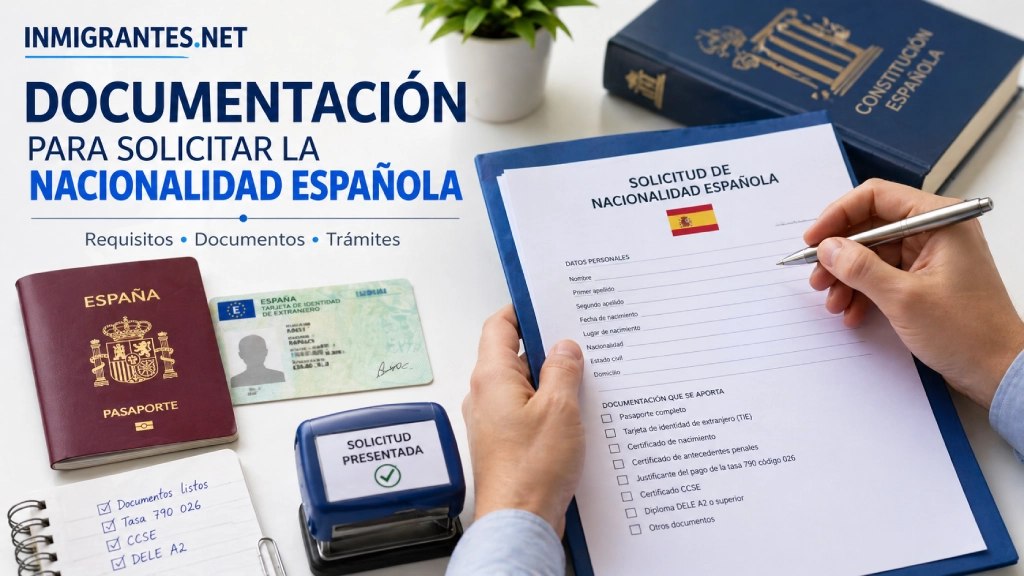
The exact documents required depend on the route used to apply for citizenship and the applicant’s personal circumstances. Even so, for Spanish citizenship by residence, the most common route, there are a number of documents that are usually essential.
| Document | Purpose | Practical tip |
|---|---|---|
| Application form | Identifies the applicant and the type of application. | If you apply online, this is replaced by the online form on the government portal. |
| Full passport | Proves identity, nationality, and entries into and exits from the country. | It must be valid and match the nationality declared for your residence authorization. |
| TIE, residence card, or EU registration certificate | Proves your lawful residence in Spain. | Check that your details match those in your passport. |
| Birth certificate | Proves parentage, date, and place of birth. | It must be legalised/apostilled and translated where applicable. |
| Criminal record certificate | Confirms the applicant’s criminal record in their country of origin. | It must be valid, legalised/apostilled and translated where applicable. |
| Proof of payment of the fee, Form 790, Code 026 | Confirms payment of the citizenship application fee. | Without payment of the fee, the application cannot be processed correctly. |
| CCSE certificate | Confirms knowledge of Spain’s constitutional and sociocultural aspects. | It is not required for minors or for people who are exempt or waived from taking the test. |
| DELE A2 diploma or higher | Confirms a basic knowledge of Spanish. | It is not usually required of nationals of countries where Spanish is an official language. |
General requirements for applying for Spanish citizenship by residence
In addition to providing the required documents, applicants must meet a number of substantive requirements. Submitting paperwork alone is not enough: the Ministry of Justice assesses lawful residence, continuity, integration and good civic conduct.
- Lawful residence in Spain for the required period, depending on the applicant’s circumstances.
- Continuous residence immediately before submitting the application.
- Good civic conduct, with no problematic criminal or police records.
- Integration into Spanish society, usually demonstrated by passing the CCSE and DELE tests, where applicable.
- Valid and consistent documents, with no discrepancies in names, dates, nationality or personal details.
- Payment of the administrative fee using Form 790, Code 026.
How many years of residence are required to apply for Spanish citizenship?
The required period of lawful residence depends on the applicant’s circumstances. The standard period is ten years, but significant reductions apply in some cases.
Standard period for applying for Spanish citizenship by residence.
For people who have been granted refugee status.
For nationals of Ibero-American countries, Andorra, the Philippines, Equatorial Guinea or Portugal, and for Sephardic Jews.
For special cases, such as marriage to a Spanish citizen, birth in Spain or certain family ties.
Related guides
For more information on each point, you can also link from this post to these related pages:
Fee 790, Code 026 for Spanish citizenship
An application for Spanish citizenship by residence is subject to an administrative fee. This fee is paid using Form 790, Code 026, which must be downloaded from the Ministry of Justice’s Government online portal.
The payment receipt is an important document in your application file. If it is missing, paid incorrectly or does not correspond to the correct procedure, your application may be considered incomplete.
Tips on the fee
- Always download the form from the Ministry of Justice’s Government online portal.
- Do not use old photocopies of the form, as each form may have its own codes.
- Keep the payment receipt validated by the bank or the relevant system.
- Check that the fee is for Spanish citizenship by residence.
CCSE test for Spanish citizenship
The CCSE test assesses knowledge of Spain’s Constitution and sociocultural aspects. It is one of the most important tests for citizenship by residence, except in cases where an exemption or waiver applies.
The Constitution, the organisation of the state, and Spanish culture, history and society.
25 multiple-choice or true/false questions.
45 minutes.
The certificate is valid for 4 years from the date you pass the test.
Practise for free
Preparing for the CCSE exam?
Before submitting your citizenship application, check your level with our free Spanish citizenship test.
DELE A2 test: when is it required?
The DELE A2 or higher certifies a basic knowledge of Spanish. It is compulsory for many people applying for Spanish citizenship by residence, but not for all applicants.
In general, people who are nationals of a country where Spanish is an official language do not usually need to submit the DELE A2. By contrast, people from non-Spanish-speaking countries normally need to demonstrate their knowledge of Spanish with the relevant diploma, unless an applicable exemption or waiver applies.
Tip: if you need to take the CCSE or DELE, do not leave it until the last minute. Even if you have already met the residence requirement, your application file may be incomplete if you do not yet have the required certificates.
Additional documents depending on your circumstances
In addition to the general documents, some people must provide specific documentation. This may apply, for example, if you are applying for citizenship because you are married to a Spanish citizen, if you were born in Spain, if you are a refugee, if you are a minor or if you are applying through a representative.
| Situation | Common additional documents |
|---|---|
| Married to a Spanish citizen | A full Spanish marriage certificate, the Spanish spouse’s birth certificate, and a certificate of cohabitation or joint municipal registration. |
| Born in Spain | A full birth certificate registered with the Spanish Civil Registry. |
| Minor | Documents from legal representatives, authorization where applicable, and a certificate from the school, training centre or care centre, where relevant. |
| Voluntary representative | Authorisation, power of attorney or document proving representation. |
| Refugee or stateless person | Documentation issued by the Ministry of the Interior proving this status, when it replaces documents from the country of origin. |
How to submit a Spanish citizenship application
The most common and recommended method is to apply online through the Ministry of Justice’s Government online portal, especially as it allows you to attach digitised documents and track your application.
Basic steps
- Check that you have already met the required residence period.
- Gather your personal, criminal record, civil status and residence documents.
- Have foreign documents legalised, apostilled and translated when necessary.
- Take the CCSE exam and, where applicable, the DELE A2 or a higher level.
- Pay the Form 790, Code 026 fee and keep the payment receipt.
- Submit your application through the Government online portal or via an authorised method.
- Keep the submission receipt and check your application status.
Common mistakes when preparing your documents
Many applications are delayed because of errors that could have been avoided before submission. Here are some of the most common:
- Submitting expired certificates or certificates that are not valid for long enough.
- Failing to have foreign documents legalised or apostilled.
- Failing to translate documents that are not in Spanish.
- Uploading files that are blurry, cropped or illegible.
- Discrepancies in names, surnames, dates or document numbers.
- Failing to provide the CCSE or DELE certificate when required.
- Paying the wrong fee or attaching an incorrect payment receipt.
- Failing to check electronic notifications after submitting the application.
You may also be interested in
Frequently asked questions about documents for Spanish citizenship
What documents do I need to apply for Spanish citizenship?
For Spanish citizenship by residence, you will usually need the application form, your complete passport, TIE or residence document, birth certificate, criminal record certificate from your country of origin, proof of payment of the Form 790, Code 026 fee, and CCSE and DELE certificates where applicable.
Do foreign documents need to be apostilled or legalised?
Yes. Documents issued by foreign authorities usually need to be legalised or apostilled, depending on the country of issue. They may also need a sworn translation if they are not in Spanish.
How much is the Spanish citizenship application fee?
The fee for Spanish citizenship by residence is paid using Form 790, Code 026. The Ministry of Justice lists the current amount as 104,05 €, although it may be revised under the applicable budgetary regulations.
Is the CCSE exam compulsory?
Generally, yes. The CCSE assesses knowledge of Spain’s constitutional and sociocultural aspects. Minors and people whose legal capacity has been modified by a court are exempt, and waivers may be granted in certain cases approved by the Ministry of Justice.
Do I have to submit the DELE A2 certificate?
The DELE A2 or a higher level certifies knowledge of Spanish. It is generally required of applicants from countries where Spanish is not an official language. Nationals of Spanish-speaking countries are usually exempt from this language test.
What documents do I need if I am married to a Spanish citizen?
In addition to the general documentation, applicants are usually required to provide a full Spanish marriage certificate, the Spanish spouse’s full birth certificate, and a certificate of cohabitation or joint municipal registration.
Can I submit my Spanish citizenship application online?
Yes. You can submit an application for Spanish citizenship by residence online through the Ministry of Justice’s government online portal, attaching scanned copies of the documents.
What happens if a document is missing?
If documents are missing or there is a defect, the Ministry of Justice may request that you provide or correct them. If you do not respond properly, your application may be delayed, archived or ultimately refused.
Final note: The documents required may vary depending on your nationality, age, marital status, application route and personal circumstances. Before submitting your application, check that all documents are valid, complete, legalised, translated where necessary and scanned correctly.
This content is for informational purposes only and does not replace professional legal advice or information provided by the competent authorities.