Form EX-15: how to apply for a NIE and certificates in Spain
Before starting the procedure: requirements and procedures may change. Check the information applicable to your case and consult the relevant official sources.
UPDATED GUIDE
Practical guide to applying for a NIE, resident certificates and non-resident certificates
Learn when to use Form EX-15, which documents to prepare, which fee to pay and which mistakes to avoid before attending your appointment or submitting your application.
Form
EX-15
Procedures
NIE and certificates
Standard fee
790 Code 012
Key point
Justify the reason for your application
Quick summary
- Form EX-15 is used to apply for a NIE and certain immigration certificates.
- It can be used to apply for the assignment of a NIE, a resident certificate or a non-resident certificate.
- Having a NIE is not the same as having a residence authorization or a TIE.
- You will normally need to pay the Form 790, Code 012 fee.
- To apply for a NIE, you must show that you have economic, professional or social interests in Spain.
- Depending on the circumstances, the application is usually submitted to the Policía Nacional, an Immigration Office or a Consular Office.
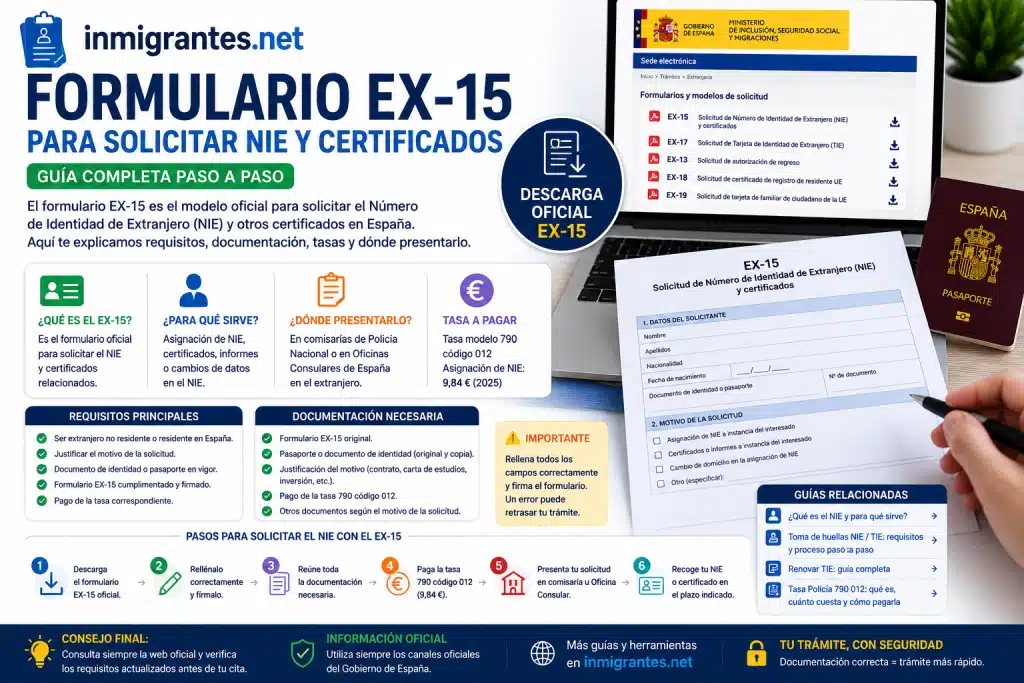
The EX-15 form is the official form used to apply for a Foreigner Identification Number, known as a NIE, and to request certain certificates relating to a foreign national’s status in Spain.
It is one of the most commonly used forms for Spanish immigration procedures, particularly by people who need to identify themselves to the Spanish authorities for economic, professional or social reasons. It is also used to apply for certificates of residence or non-residence.
Key point
The EX-15 form cannot be used to apply for a residence card or a TIE. The EX-17 form is normally used for the Foreigner Identity Card. The EX-15 form is for NIEs and certificates.
What is the EX-15 form?
The EX-15 form is the official application for a Foreigner Identification Number and certificates. It allows you to begin procedures relating to a foreign national’s administrative identification in Spain.
A NIE is a unique, personal identification number that identifies a foreign national in certain Spanish procedures. It may be required to buy a property, open a bank account, sign certain contracts, complete tax procedures, set up a company or manage professional matters.
However, a NIE on its own does not always prove legal residence in Spain. It is important to distinguish between an identification number, a certificate and a residence authorization.
What is the EX-15 form used for?
The EX-15 form is mainly used for three types of applications:
NIE assignment
To obtain a Foreigner Identification Number when you have economic, professional or social interests in Spain.
Certificate of residence
To officially prove residence status when you are eligible to apply for this certificate.
Certificate of non-residence
To obtain a certificate confirming that the foreign national is not registered as a resident in Spain.
If you would like to see other related forms, you can consult our guide to Spanish immigration forms and application forms to download.
The difference between a NIE, TIE and certificate
It is common to think that a NIE, a TIE and a certificate are the same thing. They are not.
| Document | What it is | Usual form |
|---|---|---|
| NIE | Foreigner Identification Number. Administratively identifies a foreign national. | EX-15 |
| TIE | Physical card documenting a residence or stay authorization in many cases. | EX-17 |
| EU registration certificate | Registration document for EU citizens who reside in Spain for more than three months. | EX-18 |
| Certificate of residence or non-residence | Certificate issued to prove a specific administrative status. | EX-15 |
For procedures involving a physical card, you can also read our guide to NIE/TIE fingerprinting. If you are an EU citizen, see our guide to the EX-18 form and EU registration certificate.
Who can apply for an NIE using Form EX-15
A foreign national who needs to interact with Spain for a justified reason can apply for an NIE. The Policía Nacional (National Police) lists economic, professional or social interests as grounds for assigning an NIE at the applicant’s request.
Common examples include:
- Buying a property or carrying out a real estate transaction in Spain.
- Opening a bank account when required by the bank.
- Setting up a company or becoming a partner in one.
- Signing certain contracts that take effect in Spain.
- Handling tax or other tax-related procedures.
- Managing an inheritance, deed, property sale or purchase, or notarial procedure.
- Demonstrating a specific professional, economic or administrative need.
Practical tip: It is not enough to say, “I want an NIE.” You must explain and justify why you need the number in Spain. Bring documents supporting the reason for your application.
Documents required for Form EX-15
The documents required may vary depending on the procedure and the office, but you will generally need to prepare:
- Completed and signed Form EX-15.
- Valid, complete passport, identity document, travel document or registration certificate, as applicable.
- Copy of your identity document or passport.
- Proof of the reason for your application: contract, deed, notarial appointment, bank document, professional document, tax documents or other supporting evidence.
- Proof of payment of fee 790, Code 012.
- Appointment, if required by the relevant office.
- The representative’s documents, if someone else is acting on your behalf.
Important
Bring the originals and copies. Some offices may request additional documents depending on the reason for your application or the province where you submit it.
How to fill in Form EX-15 step by step
Complete the form with clear information that matches your passport or identity document. Check names, surnames, nationality, address and reason for applying in particular.
- Download Form EX-15 from an official source.
- Enter the foreign national’s details exactly as they appear in their passport or identity document.
- Provide a valid address for notifications.
- Select whether you are applying for an NIE assignment, a resident certificate, a non-resident certificate or another certificate.
- Explain the reason for your application in the relevant section.
- Add the representative’s details only if applicable.
- Enter the place and date.
- Sign the form before submitting it.
- Check that no pages, required information or supporting documents are missing.
Recommended official links
Which box to tick on Form EX-15
The box depends on the procedure you need to complete. Do not select an option at random, as each application has a different purpose.
| You need | Option to check | Example of reason |
|---|---|---|
| Obtain a NIE for the first time | Assignment of a Foreigner Identification Number (NIE). | Buying property, tax procedures, or economic or professional activity. |
| Certificate of residence | Certificate of residence. | Prove a specific administrative situation. |
| Certificate of non-residence | Certificate of non-residence. | Banking, notarial, tax or administrative procedures. |
| Another certificate | Certificates or reports requested by the applicant. | This depends on the certificate requested. |
Form 790 fee, Code 012, for EX-15
Form EX-15 is usually submitted with proof of payment of the fee, Form 790, Code 012. The amount depends on the specific procedure you select.
| Procedure | Fee description | Current official amount |
|---|---|---|
| NIE assignment | Assignment of a Foreigner Identification Number (NIE) at the applicant's request. | 9,84 € |
| Certificates or reports | Certificates or reports issued at the applicant's request. | 7,31 € |
Before paying, always check the current amount on the official government portal. If you select the wrong fee description, the fee may not be valid for your procedure.
For more information, see our guide to the National Police fee, Forms 790 and 012.
Where to submit Form EX-15
The submission process may vary depending on the procedure and the applicant’s circumstances. In Spain, applications are usually submitted at National Police stations or Immigration Offices, generally by appointment. If you are outside Spain, in some cases you can apply through a Consular Office.
Before attending, check which office is responsible in your province or country, the exact appointment procedure and the required documents. Booking the wrong appointment can waste your time.
Common mistake
Booking a TIE appointment when you need an NIE to be assigned, or an NIE appointment when you actually need a physical card, may mean you are not seen. Check the procedure carefully before booking.
Can a representative submit the application?
In some cases, a representative may act on your behalf, but their authority to represent you must be properly documented. Form EX-15 includes sections for the legal representative’s details, where applicable.
If someone else is acting on your behalf, it is advisable to bring an authorisation, the representative’s identity document and documents proving their authority to represent you. Consular procedures and specific offices may require additional documents.
Common mistakes when applying for an NIE or certificates using EX-15
Failing to justify the reason
You must explain and provide evidence of why you need the NIE or certificate.
Confusing an NIE with residence
The NIE identifies you, but does not always prove that you are legally resident.
Paying the wrong fee
You must select the correct fee item on fee form 790, Code 012.
Incorrectly written details
Your first name, surname, nationality and passport details must match your documents.
Failing to sign the form
An unsigned form may not be accepted.
Bringing incomplete copies
Bring the original documents, copies and the complete proof of payment.
Checklist before submitting EX-15
- You have downloaded Form EX-15 from an official source.
- You have correctly selected whether you are applying for an NIE, a resident certificate or a non-resident certificate.
- You have completed all personal details without errors.
- You have explained the reason for your application.
- You have documents to support that reason.
- You have paid the relevant fee: Form 790, Code 012.
- You have the complete, legible proof of payment.
- You have a valid passport or identity document.
- You have the original documents and copies.
- You have booked the correct appointment or confirmed how to submit your application.
Frequently asked questions about form EX-15
▸ What is form EX-15?
This is the official form for applying for a Foreigner Identification Number (NIE) and certain certificates, such as a resident or non-resident certificate.
▸ Can I use form EX-15 to apply for a TIE?
No. Form EX-17 is normally used to apply for a Foreigner Identity Card (TIE). Form EX-15 is used for NIEs and certificates.
▸ What fee must I pay for form EX-15?
You normally pay the fee on Form 790, Code 012. The amount depends on whether you are applying for a NIE or a certificate.
▸ How much does it cost to apply for a NIE?
The current official fee for assignment of a NIE at the applicant’s request is 9,84 € according to the National Police fee schedule.
▸ How much does it cost to request a resident or non-resident certificate?
Certificates or reports issued at the applicant’s request currently have an official fee of 7,31 €.
▸ Do I need to explain why I am applying for a NIE?
Yes. You must provide evidence of the reason for your application, which is generally related to economic, professional or social interests in Spain.
▸ Where do I submit form EX-15?
Depending on the case and where you are applying from, you can submit it to a National Police office, an Immigration Office or a Consular Office.
Conclusion
Form EX-15 is the one to check if you need to apply for a NIE or a resident or non-resident certificate. The key is to select the right option, explain your reason, pay the correct fee and bring all the required documents.
Before submitting your application, check that the procedure you need is actually EX-15, not EX-17, EX-18 or another immigration form.
Official sources
This content is for informational purposes only and does not replace professional legal advice or information provided by the competent authorities.