Spanish Immigration Forms and Application Forms to Download

Before starting the procedure: requirements and procedures may change. Check the information applicable to your case and consult the relevant official sources.
Updated guide
Find out which EX form you need for your residence, NIE, TIE, return authorization, EU registration certificate, arraigo, change of authorization or renewal procedure. Using the correct form helps avoid delays and requests to provide missing or corrected documents.
Forms
EX-00 to EX-32
Fees
790-012, 790-052 and others
Procedures
Residence, NIE, TIE and return authorization
Key tip
Always download the official form
Quick summary
- Spanish immigration forms are official forms required to start or complete procedures in Spain.
- The most frequently searched forms are EX-13, EX-15, EX-17, EX-18, EX-19, EX-10, EX-24, EX-31 and EX-32.
- Some procedures also require a fee, usually paid using Form 790.
- Using the wrong form may result in your application being rejected or a request to provide missing or corrected documents.
- It is advisable to always download the latest official version before submitting your application.
Spanish immigration forms are official documents used to apply for authorizations, certificates, cards and other procedures related to the residence or stay of foreign nationals in Spain. Each procedure has its own form, and choosing the right one is an essential part of the process.
This guide provides a clear explanation of the main EX forms, what each one is for, when it is used, which fees may apply, and where to download the official forms. This page is intended as a practical index to help you find your way before starting any procedure.
Key point
Not all Spanish immigration procedures use the same form. For example, EX-13 is used for a return authorization, EX-18 for an EU citizen registration certificate, EX-15 for a NIE and certificates, and EX-17 to apply for a TIE.
What are Spanish immigration forms?
Spanish immigration forms are standardised forms used to start administrative procedures with Immigration Offices, police stations, government online portals, consulates, or other competent authorities.
They are generally identified by the abbreviation EX followed by a number. The number indicates the type of application: temporary residence, residence and employment, a return authorization, a NIE, a TIE, an EU registration certificate, a residence card for a family member of an EU citizen, arraigo (a Spanish residence route based on ties to Spain), a change of residence authorization, or another procedure.
The form alone is usually not enough. In most cases, it must be accompanied by personal documents, supporting evidence, proof of payment of fees, and documents specific to the procedure.
Where to download official Spanish immigration forms
The safest way to download forms is to use official sources. General application forms are available on the Migration portal of the Ministry of Inclusion, Social Security and Migration. Some police procedures, such as those for a TIE, NIE, return authorization, or EU registration certificate, are also handled through the National Police Electronic Office.
Recommended official links
Avoid downloading forms from unofficial websites unless you are sure they are up to date. An outdated form may lead to errors, particularly if the procedure's name, regulations, fields, or process have changed.
Quick reference table of the most commonly used EX forms
Here are some of the most commonly used EX forms and their main purpose:
| Form | Purpose | Related procedure |
|---|---|---|
| EX-00 | Long-term stay authorization. | Studies, training, or a stay of more than 90 days, depending on the case. |
| EX-01 | Non-lucrative temporary residence. | Living in Spain without engaging in work. |
| EX-02 | Temporary residence through family reunification. | Bringing family members to Spain, subject to the applicable requirements. |
| EX-03 | Temporary residence and employment. | Employment with a company. |
| EX-07 | Temporary residence and self-employment. | Self-employed or professional activity. |
| EX-09 | Temporary residence with an exemption from a work permit. | Special cases exempt from the standard work authorization. |
| EX-10 | Residence on exceptional grounds. | Arraigo (residence routes based on ties to Spain), humanitarian grounds and other exceptional cases. |
| EX-11 | Long-term residence or EU long-term residence. | Permanent residence after meeting the requirements. |
| EX-13 | Return authorization. | Leave and return to Spain while your residence permit or TIE application is being processed. |
| EX-15 | NIE and certificates. | NIE assignment, resident or non-resident certificate. |
| EX-16 | Registration certificate or travel document. | Undocumented foreign nationals or special situations. |
| EX-17 | Application for a Foreigner Identity Card (TIE). | Issue, renewal or replacement of a TIE. |
| EX-18 | Central Register of Foreign Nationals for EU citizens. | EU registration certificate or EU residence certificate. |
| EX-19 | Residence card for a family member of an EU citizen. | Non-EU family members of EU citizens. |
| EX-24 | Temporary residence for family members of Spanish nationals. | New regime for family members of Spanish nationals. |
| EX-26 | Change to a residence or stay authorization. | Change the type of authorization or immigration status. |
| EX-29 | Extension of a short-stay authorization. | Extend a short stay in permitted circumstances. |
| EX-31 | Arraigo for applicants for international protection in specific circumstances. | Residence on exceptional grounds under the applicable provision. |
| EX-32 | Exceptional arraigo. | Exceptional regularization in specific circumstances. |
Which form do I need for my procedure?
The easiest way to choose the right form is to start with the procedure you want to complete. Here are some common situations:
I want to apply for a return authorization
Use EX-13. You can read the full guide to return authorization.
I want to apply for a NIE or certificate
The EX-15 is generally used to apply for a NIE, a resident certificate or a non-resident certificate.
I need to apply for a TIE
The usual form is EX-17. You may also find the guide to NIE/TIE fingerprinting useful.
I am an EU citizen and will live in Spain
You should check EX-18. Here is the guide to the EU registration certificate in Spain.
I am a family member of an EU citizen
The usual form is EX-19 if you are a non-EU family member of a Union citizen.
I want to apply for arraigo
Check EX-10, EX-31 or EX-32, depending on the type of arraigo or exceptional circumstance that applies.
EX forms and Form 790 fees are not the same
A common mistake is to confuse the EX form with the fee. The EX form is the application for the procedure. Form 790 is used to pay the applicable administrative fee when the procedure requires it.
| Document | What it is | Example |
|---|---|---|
| EX form | Application form for the procedure. | EX-13 for a return authorization, EX-18 for an EU registration certificate. |
| Form 790 | Administrative fee payment form. | 790-012 for Police procedures, 790-052 for certain immigration procedures. |
| Proof of payment | Evidence that the fee has been paid. | Online payment PDF or copy stamped by the bank. |
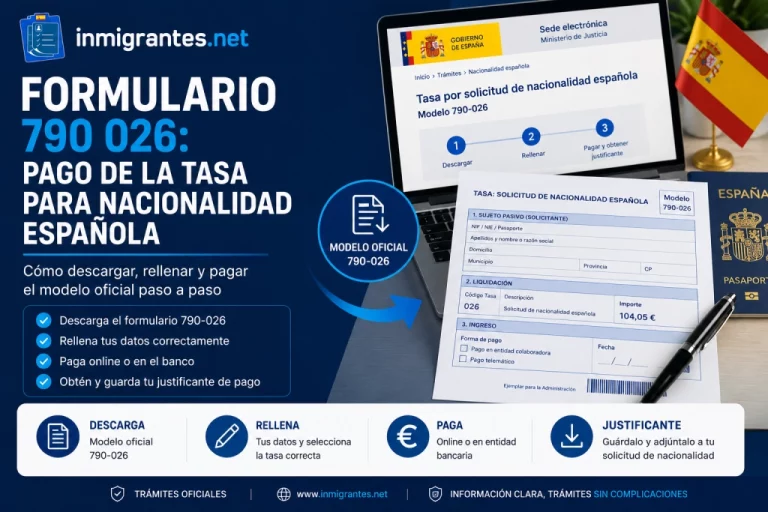
For more information, you can read our guides on the Police fee 790 012, the fee 790 052 and the Spanish citizenship 790 026 form.
Key forms explained
EX-13: Return authorization
The EX-13 is used to apply for return authorization when a foreign national needs to leave Spain and return while their residence or stay authorization, or TIE, is being processed, renewed, extended or replaced. It is usually accompanied by the Form 790, Code 012 fee.
EX-15: NIE and certificates
The EX-15 is used to apply for a NIE and certain certificates, such as a certificate of residence or non-residence. It is commonly used by foreign nationals who need to be identified for administrative purposes in Spain.
EX-17: Foreigner Identity Card
The EX-17 is used to apply for a Foreigner Identity Card (TIE). It is commonly used after obtaining a residence or stay authorization, for renewals or replacement cards, and for initial card issuance.
EX-18: EU Citizen Registration Certificate
The EX-18 is used to register in the Central Register of Foreign Nationals as a citizen of the European Union, European Economic Area or Switzerland who will be residing in Spain for more than three months.
EX-19: Residence card for a family member of an EU citizen
The EX-19 is the form used to apply for a residence card for a family member of an EU citizen. Depending on the circumstances, it is relevant to non-EU family members of Spanish, EU or European Economic Area citizens.
EX-10, EX-31 and EX-32: exceptional circumstances and arraigo
The EX-10 has been used for authorizations based on exceptional circumstances. New forms also include EX-31 and EX-32 for specific arraigo (residence routes based on ties to Spain) and extraordinary regularization cases. Before submitting an arraigo application, check exactly which form applies to your case.
How to fill in an immigration form correctly
Although each form has its own sections, there are some general rules to follow:
- Download the form from an official source.
- Check that the form number matches your procedure.
- Enter your details exactly as they appear on your passport, NIE or TIE.
- Tick only the box that applies to your application.
- Provide a postal address and email address where you can receive correspondence.
- Sign the form before submitting it.
- Include the required supporting documents with the form.
- Pay the relevant fee if required for the procedure.
- Keep a copy of everything you submit.
Practical tip: if you fill in the form using an editable PDF, download a final PDF copy before printing or submitting it. Check that no details have shifted, been cut off or disappeared when saving.
Documents commonly required with EX forms
The form is just one part of the application. Depending on the procedure, you may be asked to provide documents such as:
- A complete, valid passport.
- Your previous NIE or TIE, if you have one.
- Municipal registration certificate.
- Employment contract, Social Security registration or employment documents.
- Sufficient financial means.
- Public or private health insurance.
- Birth, marriage or criminal record certificates.
- Documents legalised, apostilled or translated if issued abroad.
- Proof of payment of the relevant fee.
- Proof of appointment or receipt for electronic submission.
If you are submitting foreign documents, you may also find our guides on the criminal record certificate, birth certificate and legalisation or apostille procedures useful.
In-person or online submission
Some forms must be submitted in person by appointment, while others can be submitted through electronic registries, immigration platforms or authorised systems. This depends on the procedure, the province and the applicant’s circumstances.
In-person submission
You may need to book an appointment at an Immigration Office, police station or authorised registry office.
Online submission
This can be done using a digital certificate, Cl@ve or systems such as Mercurio, if the procedure allows it.
Consulate
Some visas or applications submitted from outside Spain are processed by the relevant consular office.
For online applications, you can also consult our guide to the Mercurio system for Spanish immigration applications.
Common mistakes when using Spanish immigration forms
Using an outdated form
Always download the latest official version before submitting your application.
Choosing the wrong form
EX-13, EX-15, EX-17 and EX-18 are different procedures. They are not interchangeable.
Failing to sign the form
An unsigned application may not be accepted or may lead to a request for additional documents.
Mismatched information
Your first name, surname, date of birth and document number must match your passport or TIE.
Paying the wrong fee
Some procedures require 790-012; others require 790-052 or a different fee.
Attending the wrong appointment
Choosing the wrong procedure when booking an appointment may mean you are not seen.
Checklist before submitting any EX form
- You have checked which procedure you want to complete.
- You have chosen the correct EX form.
- You have downloaded the form from an official source.
- You have filled in all the required information.
- The form is signed.
- You have the original documents and copies with you.
- You have paid the fee, if applicable.
- The proof of payment is legible and complete.
- You have booked the correct appointment or prepared to submit your application online.
- You have kept a copy of everything you sent or submitted.
Frequently asked questions about Spanish immigration forms
Where can I download Spanish immigration forms?
It is advisable to download them from the official Migration portal of the Ministry of Inclusion or, for procedures handled by the police such as the TIE, NIE, return authorization or EU registration certificate, from the National Police’s online portal.
What is the difference between an EX form and a fee 790?
The EX form is the application form for the procedure. Fee 790 is the document used to pay the administrative fee when the procedure requires it.
Which form do I need for a return authorization?
To apply for a return authorization, use form EX-13. You will normally also need to provide proof of payment of fee 790 Code 012.
Which form is used to apply for a TIE?
To apply for a Foreigner Identity Card (TIE), use form EX-17, together with the documents and fee required for your case.
Which form should an EU citizen use to reside in Spain?
An EU, European Economic Area or Swiss citizen planning to live in Spain for more than three months should check form EX-18 to apply for a registration certificate.
Can I submit an old form?
It is not recommended. If you submit an outdated form, the office may ask you to provide missing or corrected documents, or may reject your submission. Always download the current official version before starting the procedure.
Are all Spanish immigration forms submitted to the same office?
No. Some are submitted to an Immigration Office, others to the National Police, others through the electronic registry, and some at the consulate. It depends on the procedure and the applicant’s circumstances.
Conclusion
Spanish immigration forms are the starting point for many procedures in Spain. Choosing the right EX form, downloading the official version, completing it correctly, and submitting it with the appropriate fee and documents can help prevent delays, missed appointments and requests for additional documents.
Before submitting any application, check the exact form, the competent office and the applicable fee. For important procedures, a small mistake on the form can delay the entire application.
Official sources
This content is for informational purposes only and does not replace professional legal advice or information provided by the competent authorities.